Mon 11th – Wed 13th Aug.
The weather has turned. Following Sun night’s downpours, it’s gone much cooler. Not the best time to be touring the Fränkische Seeland but it’s only 1 1/2 hours away from Heiligenstadt and just to the South of Nuremberg. We’ve decided not to “do” Nuremberg and Munich for several reasons, so this gives us 3 days to enjoy the area before heading back to Ehningen for Clara’s 2nd birthday.
We found an excellent Stellplatz in Heubach; near Hilpoltstein. It’s about 150m from the edge of the lake (Rothsee). Hilpoltstein is within easy cycling distance, just over the other side of the Main-Donau Kanal.

Hilpoltstein – yet another unspoilt and very old town centre with all the shops we would need. The Brauerei Gasthof zum schwarzen Ross (sadly no longer a brewery) houses a small museum that was unfortunately closed whilst we were there. In fact, much of Hilpotstein was closed or about to close for the rest of August.

The Gasthof clearly used to be a coaching house containing a yard (Hof) with what used to be stables. There’s a public footpath running from the road, through the Hof and down some steps at the back through part of what used to be the old town walls. There are also the remnants of a moat just outside the wall.
We stay for a beer but it’s pretty cool so we decide to head back to the van for tea.
More rain and a cold night followed by a bike ride around the lake in the morning. There are a couple of nature reserves around the lake and they’re full of geese and ducks.

A great pity the weather’s so cool: the lake is really warm, there’s a sandy beach, kid’s playground, bar/cafe, sailing club and boat hire. Clearly a very popular holiday destination, but pretty deserted right now – and it’s the middle of August, for goodness sake.

When we cycled on the bridge across the Main-Donau Kanal, we noticed a lock a few hundred metres away so decided to go and take a look.
As I may already have mentioned, the barges travelling the canal can be up to 190 m long and 12 m wide. That is big. What I hadn’t realised from the road is that the lock drops the canal by a staggering 25 m (near enough 80 feet). We were lucky enough to catch a big barge negotiating the lock, and the builders of the lock were kind enough to provide a viewing platform. It would have been rude not to watch.

We missed the barge entering the lock but saw the top lock gate rise up from the canal behind the ship’s stern. This was clearly not like any lock I’d ever seen before.
We quickly walked down to the far (lower) end of the lock and had to climb several flights of stairs to reach the viewing platform. By the time we got there, the lock was already half empty and we were staring down the dizzying sides at the slowly descending barge.

Eventually the lock was low enough and the lower door opened: The entire steel lower section – probably 50 or 60 tonnes-worth of steel – lifts up on chains providing a gap just large enough for the barge to fit under.
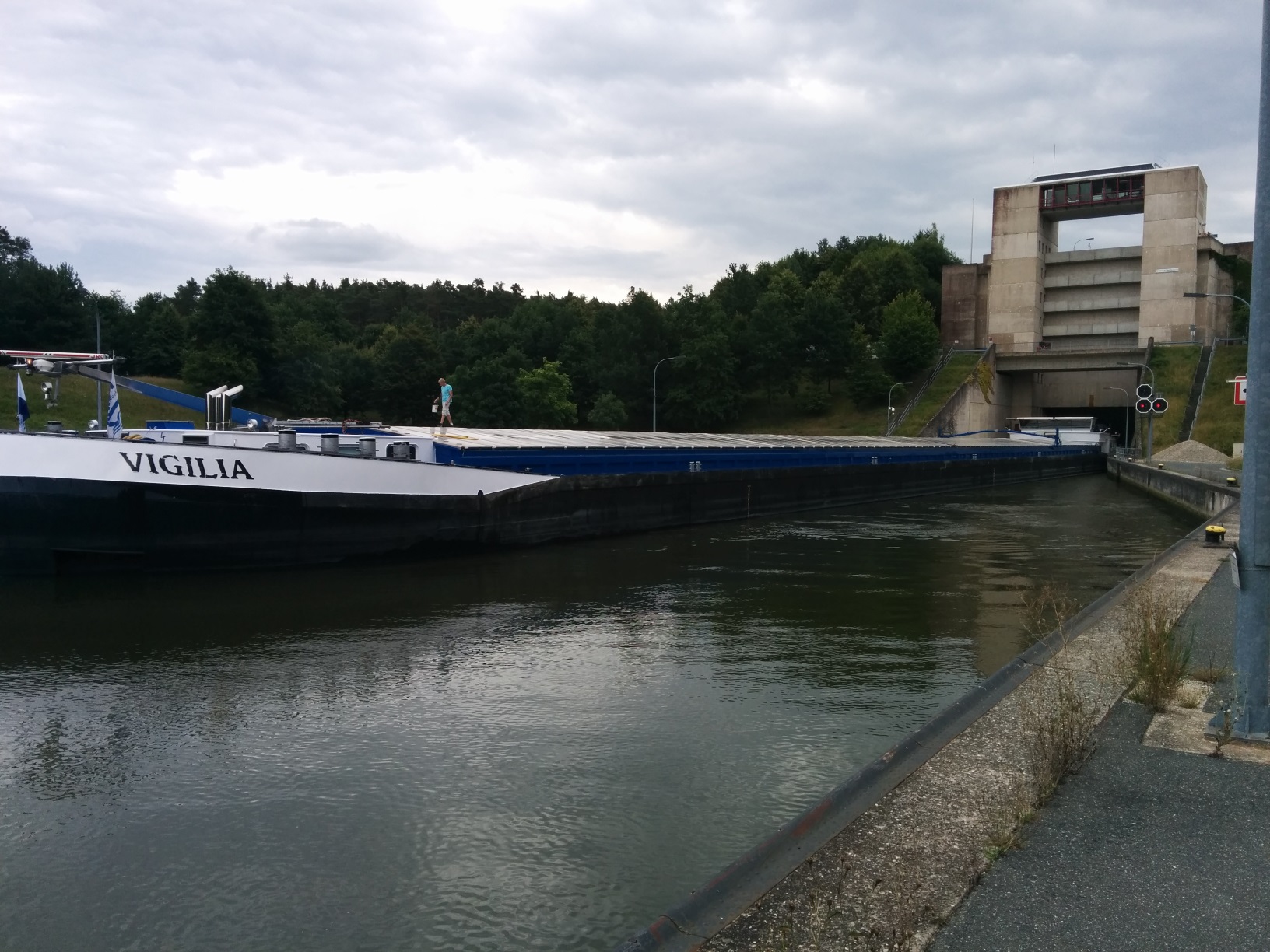
For the technically-minded, here are some details of the lock:
- Dimensions: 200m x 12m (useable width) x 24.75m drop
- Water volume: 60,639 cubic metres
- Water usage per navigation: 24,698 cubic metres
- Water level rise/fall rate: 1.5m/minute
- Built between 1980 and 1985.
- First used (when the canal opened): 1991
- Time to negotiate: 25mins
Unlike locks on our canals at home, where water must always be pumped up to the highest level and all the water from the lock is allowed to flow out of the lock (and is therefore “lost”), this locks preserves most of the water from each use by a very clever system of emptying it successively into 3 huge adjacent storage tanks set at varying heights corresponding to the water-level heights in the lock. This way, water can flow under gravity from the lock into the highest tank first, then – as the lock level drops, the top tank is sealed and water can then flow under gravity into the middle storage tank. Similarly for the 3rd (lowest) tank. When the lock is being filled, this whole process then runs in reverse. By this means, most of the water per navigation is preserved, and minimal energy is required for pumping. Clever stuff.
Sleep was disturbed by a family with 2 kids & 2 dogs who’d parked very close by: To be fair, they weren’t particularly noisy but a group of people 5 metres away chatting and laughing into the night when sound travels easily is a bit annoying.
Time to move to Brombachsee…