Mishaps and Dole

Fri 22nd Aug.

A morning of mishaps. A later-than-hoped-for departure from the campsite in Ihringen preceded a drive into town to a supermarket to stock up on essentials (German beer, primarily. But this is a wine region and the beer selection was poor.).

On the way into Ihringen is a petrol station that also sells LPG/Autogas (we have a refillable LPG gas system on the van so we needn’t worry about swapping gas cylinders, which is actually very difficult when crossing country borders as a gas cylinder from one country can’t be swapped/refilled in a different country). The LPG pump displayed a very large notice to the effect that it was illegal to use LPG for anything other than driving the engine. Hmm. I’d heard rumours about this but this was the first time I’d come across it. So we decided to be good citizens and not fill-up our tank here. Less good in the citizenship stakes was that I managed to remove part of the roof over the LPG pump whilst driving away as the overhanging back-end of the van swung out and caught it amidships with a loud cracking sound. Fortunately the van is undamaged other than a few scratches on the awning caused by breaking polycarbonate roof panels. To be fair, the lady in the petrol station was very matter-of-fact about it as we swapped insurance details, and even said she hoped that was the worst thing that would happen to us today. It was. Just.

In the supermarket (as in almost all German supermarkets), there’s a machine for returning your empty plastic bottles, and another for returning your empty beer bottles. Both machines issue credit slips for the refunds on the bottles. These credit slips can be cashed-in at the check-out (smart machines, they have a laser scanner inside them that scans the barcode on the labels, accepting bottles that are recognised, and declining refunds for bottles that aren’t recognised (like the Italian water bottles we’d been toting around, trying to find somewhere to recycle them!). Needless to say, one of the beer bottles failed to make it into the machine and proved no match for the concrete floor it fell upon. Fortunately, we weren’t lacerated by broken shards, and a very nice lady came and cleared away the mess.

With our tails metaphorically between our legs, we hot-footed it out of Germany and into France following guidance from “her on the windscreen”. To be honest, we had no clear idea of where we were heading. “South” was the general idea, but do we go to the Med coast, or to the Atlantic coast? And so undecided, we agreed to head for a place that was close to the “watershed” in terms of road directions: a place from which we could choose either direction. A place I’d never heard of before except as a sticker on the skin of a banana: Dole.

And so we rocked-up in Dole having driven through some beautiful countryside (“she”’s been programmed to keep us off toll roads. i.e. 99.9% of all motorways, and so we’re sticking to the main roads, most of which are really good). Much of the route was alongside the river Doubs. We parked-up at the aire along with about 20 or so other motorhomes. No facilities, but completely free of charge.

Pretty as a picture

The aire was situated between the river Doubs and the Rhine-Rhone canal, which – in Dole – formed part of the town’s defences in earlier times. It was also next to the Stade de Sport. We’d arrived just in time to see two teams coming out of the sports hall changing rooms – each team dressed in their own team colours – and make their ways 10 metres or so onto the car park which also turned out to be a boules piste. Yes – they wear team colours here for boules matches (Pat & Gaynor take note!).

Unfortunately, the aire was also adjoining a fairly busy road that continued to be used throughout the night. A bit noisy, but not too bad. At least not until an emergency vehicle went past with alarm going.  I didn’t sleep too well.

Sat23rd Aug

This morning, I wandered up into the town to find a boulangerie for an obligatory roof-of-the-mouth-shredding baguette, a croissant and a pain aux chocolat. It was a steep climb up – what I realised to be – a very ancient street. There was a hotel that used to be the town mill on a branch of the river diverted into the lower town in the 13th century. But there wasn’t a boulangerie, neither ancient nor modern. At the top of the town is the most imposing church of Notre Dame – and enormous church, originally from the 16th century and rebuilt many times – the last restoration being between 2002 and 2005. Eventually, I managed to procure the required baked items & returned for breakfast.

The Notre Dame church towering above yet another “Little Venice”
The inner “river”

After breakfast (i.e. practically lunchtime) we decided we’d both explore the town in some more detail. I don’t know how we do it, but almost every place we happen to stop in is fabulous in some way. In addition to the church, Louis Pasteur was born here – the house of his birth (a tannery) is now a museum. The town used to be the principal town of Bourgogne for many centuries. It’s a beautiful and famous town, and I’d never even heard of it.

To Louis Pasteur’s birthplace

Destination programmed in – somewhere North of Bourg-En-Bresse. We’ve decided to head down to the Med. However, we have decided to take a detour off into the alps en-route and we found a convenient Camping Municipale in St Etienne – just to the N of Bourg-En-Bresse – in which to pass the night.

Breisach – Kaiserstuhl

Thur 21st Aug:

Well, we DID make it into France, but then beat a hasty retreat back into Germany!

Actually, it turned out to be such a warm morning, that we decided to stay another day and do some cycling around this very flat part of the Kaiserstuhl. That and it was pretty late by the time we managed to get ourselves some breakfast (that’s after I’d cycled into Ihringen and back to get some Pretzeln and Brötchen (bread rolls).

With Breisach am Rhein as our destination, we followed the “official” cycle routes taking us mostly over field tracks.

This area is full of agriculture and viticulture; any slightly South-facing slope is covered in vineyards, and there are many slopes here. Ok, I said it was flat, but Ihringen is the place where the lava flows from the dormant-for-the-last-n-million-years volcanos stopped. So the land jacks up steeply just to the North of Ihringen. Any ground that’s flat is covered in orchards or maize. There are plums, apples, pears, mirabelles, and more plums. Much of this is ripening right now; the air is heady with the scent of ripe fruit and the farmers are all out harvesting. Fancy a pear? Helping yourself to one is fine as long as you don’t take the mickey and start harvesting them all! Forget the industrial scale of farms we have in the UK: most of these farmers have anything from a field of fruit trees to a row or two of redcurrant bushes, and most of them sell direct to the public. Who needs food miles?

The vineyards beyond the corn fields

Let me say it here; Breisach is another beautiful town. Perched on the Rhine overlooking France, it has a Münster sitting atop its highest point, surrounded by the old town walls and enclosing steep cobbled streets. An ancient portal through the walls still exists through which cars can now pass (just!). When we were there, they were holding their Jahresmarkt (annual market – though I strongly suspect it’s held several times a year). It was pretty rubbish, really. Apart from the cheese stall.

The Münster

Entertainment was provided by a seller of some new miracle car polish he was continually demonstrating with an old VW Golf for the benefit of the gathered throngs (i.e. no-one in particular). I didn’t take a close look at the product, but I sincerely hope it came with very large “Extremely dangerous and highly inflammable” warning notices plastered all over it. I say this because the seller demonstrated the flammability of it. I don’t know how it happened, but his bottle of stuff – which had a long spout – was in flames on the ground. The bottle itself was burning as well as the vapours, which were increasing in pressure inside the burning bottle as a result of the heat. He then tried to set his trousers on fire by standing on the bottle. The result of this was to eject more of the flammable liquid from the spout all over the pavement and thus spread the flames further. He then had the bright idea of pouring water on the whole. So now, the flaming fuel was spread even further on top of a river of water. Very smart. We beat a hasty retreat to a safe distance, anticipating the bottle would soon rupture or explode. In the meantime, he then decided to throw a rag on the flames. This would have been a good move had the rag not also been flammable, but then he threw more water over the rag which did eventually starve the flames and thus was Breisach saved.

Most of the market was just tat, so we wandered off to find a Bäckerei to get a sandwich. In this, we were wholly unsuccessful. We did, however, end up with a large slice of Käsekuchen (cheesecake) plus a buttered Pretzel each, so we wandered over to the Rhine to eat. And watch the swans. There were hundreds of them, mostly on the French side of the river.

Just for a lark, we decided to cycle over the Rhine and into France. In doing so, we discovered three petrol stations on the German side, practically shoulder-to-shoulder. This arrangement usually occurs when fuel on one side of the border is much cheaper than the other side. But everything I’d read suggested that diesel is cheaper in France than in Germany. So we decided to go further into France to find a French petrol station. We were wholly unsuccessful in this endeavour, too. Not a single petrol to be found within a 15 minute riding distance of the border. In fact, PETROL is more expensive in France, but DIESEL is cheaper (allegedly).

The Rhine here is not actually just the Rhine. That would be far too simple. There are no fewer than 3 bridges over the Rhines, these being:

  1. Yer actual Rhine
  2. The Rhine canal – which goes to and fro, joining up with the Rhine whenever it takes its fancy
  3. Something very wide & turbulent – probably being fed from the bit of Rhine canal – that seems to be driving a number of underwater, power-generating turbines. I guessed this from the facts that there were a lot of electricity power distribution transformers alongside the “weir”, and that there were EDF logos all over the installation.
Yer actual Rhine. With substantial weir.

The first bridge is obviously German. It has a generous cycle path in addition to a footpath. The second & 3rd bridges are equally obviously French. They just have narrow footpaths and cunningly hidden signs displaying graphics that supposedly suggest cyclists dismount and walk the footpath. This we only discovered when one officious lady pointed out the sign to us as we came off on the French side. Clearly we survived to see another day, but the ride was “entertaining”.

So tomorrow, we’ll head over into France (déjà vue…).

The Schwarzwald (Black Forest) and Kaiserstuhl

Sun 17th – Wed 20th Aug.

Sun:

We’d stayed with Kathryn & family for the last few days – getting back there in good time for Clara’s 2nd birthday.

We planned to move on today, possibly staying for a few days in the Schwarzwald. Kathryn suggested we all visit the Vogtsbauernhof museum in Hausach, as that would be on our way.

The museum is a collection of traditional Black Forest farmer’s houses (Bauernhöfer) – the earliest of which dates back to 1599. All but one of these houses were moved (yes, really!) to this site after it opened as a museum in 1964. The last family stayed in the house until 1965 – Barbara Abele being the eldest member – and some of the family’s living accommodation has been left as of that period. The traditional design hasn’t really changed since the 16th century and there are many such houses still in use today in the Black Forest:

Thee houses are all built into the hillside, often with the upper loft level being accessed from a road or track at the rear (uphill) side. They all have space for cattle, pigs, goats, and whatever else the farmer may have wished to keep. And there’s living accommodation for (typically) 8 – 12 people; family and farmworkers. They were built without chimneys. There were usually one or two open ranges in the large kitchen, and the smoke was allowed to disperse throughout the house. Above the ranges was a hood. Just a hood, not an extractor. In this hood, they hung meat – traditionally ham – in order to smoke, and hence, preserve it. So today, when you buy genuine Schwarzwälder Schinken (smoked ham), you’ll have a better idea of it’s heritage.

These are not small houses. They can be 100m by 75m, and have 3, 4 or 5 floors including the loft(s). Apparently, it took some 400-500 trees to build one of the farmhouses. It’s just as well there are a lot of trees in the Schwarzwald.

The original Bauernhof at Hausach, built in 1612
Detail of the front (facing into the valley) of the 1599 Bauernhof
One of the many still-in-use Bauernhöfe in the Black Forest

Kathryn & family departed for home. As the car park ticket for the museum was valid for 24 hrs, we decided to sleep there overnight. Our plan was to drive down to Titisee  – further South in the Black Forest – the next morning and spend a few days there.
Mon 18th

Plan into action: We headed South from Hausach, the road climbing all the while. There were some serious climbs that I wasn’t entirely confident the van would make. It coped ok, though often screaming at 3500rpm doing 20mph in 2nd gear.

It had been a fairly chilly start in Hausach, and I couldn’t help but notice that we were doing a lot of climbing. I’ve also learned that the higher the altitude, the colder it generally gets. By the time we got to Triberg (Any tour you make to the Black Forest WILL include Triberg with its waterfalls and cuckoo clocks) we were at 680m above sea level and it was very cold. Time for a pause and reconsider our plan.,,

Titisee lies at 1190m. It was only about 7°C in Triberg. It was going to be colder in Titisee. We consulted the forecast using my ultra-speedy Edeka SIM card in my smartphone. When we did eventually get a phone signal good enough to give us an Internet connection, we could see it was not promising over the next several days.

So… There’s an area between the Black Forest and the Rhine / French border that’s allegedly the warmest part of Germany – The Kaiserstuhl. It’s a well-known (within Germany) wine-producing area and part of the Baden wine region. We’d not yet reached the road junction where we’d need to go either one way or the other. I.e. we were still on track for both possibilities, so no need to go back on ourselves.

As we climbed higher and it got colder still, there was no question. Decision made: head for the Kaiserstuhl. We made it to a very nice but not inexpensive campsite just outside Ihringen – about 30km from Freiburg. It provides free access to the adjoining Freibad (open-air swimming pool).

Tue 19th

Lay round the pool in the 22° of sunshine and had a beer on the terrace in the evening. Could it be we made the right decision in coming here? Cracked open a not inexpensive bottle of local wine – a Spätburgunder Weissherbst. A rosé we’ve had many times. This one was one of the least good. Can’t win ’em all.

Wed 20th

Part of the fee for staying on this campsite is a one-off tax of  €1.70 per person. For this, in return, you get access to the Freibad; two free wine cellar tours with tastings (unfortunately only on days we’ll not be here); and – this is the biggy – completely free use of public transport throughout the Black Forest (with some conditions, obviously).

When we were at the Bauernhof museum the other day, I’d noticed the railway line snaking along the side of the road. We also noticed on the road map that it did a couple of convoluted loops at two points close by. Something that seemed worth investigating at first hand. And if we could do it for free…

So I spent an hour or so online looking at train timetables and connections and discovered it would be possible to do an entire loop through the Black Forest in one day. One or two of the connections would be tight, but it seemed do-able. And it would – of course – include the Schwarzwaldbahn that runs from Donaueschingen, heading NW through the Black Forest to Offenburg, past Hausach. All we had to do was to avoid any high-speed trains; inter-regional trains and some other kind of train I could find anything out about. We needed no tickets; only needing to show our Guest Card and photo ID to the conductor should we be asked.

A picture postcard Schwarzwald village
Another Schwalzwald Bauernhof

It all worked perfectly. Ihringen to Freiburg. Freiburg to Neustadt. Neustadt to Donaueschingen. Donaueschingem to Offenburg, Offenburg to Frieburg, and Freiburg back to Ihringen. Six train connections, and all of them worked out ok. We had a 1 1/2 hour break at Donaueschingen – conveniently at lunchtime – giving us time to find a Gasthof and have a Käsespätzle (sorry – can’t be translated. Ask Joy to make some for you!) mit Röstzwiebeln (with roasted onions) each. Heavy fare, but very good.

The train journey was great, but perhaps not as great as I’d hoped. The two loops by Triberg passed by without my noticing them, and the train we were on had high-backed seats – very comfortable, but  not great for spotting up-coming attractions as you couldn’t see past the seat in front. It turns out that the two loops are largely inside tunnels and they are done to gain/lose altitude in as tight a space as possible – a bit like planes circling over Kent waiting to land at Heathrow. The cost of the tickets for this journey, had we had to buy them, would have been around €65 each. Thank you Schwarzwald tourismus.

We’re now looking at heading out into France and somewhere warmer tomorrow, but the mad European weather is still holding firm. Even if we head to the far SW of France – near Bayonne / Biarritz – it’s still only 19°/20° for the next several days. Maybe we’ll head that way anyway and hope that – by the time we get there, which could be several days hence – it might warm up a bit (or a lot).

We’ll probably be without Internet again for much of the uncertain future. My German SIM card won’t work far into France, so not sure when I might be able to continue the story…

Igelsbachsee, Bayern

Wed 13th/Thur 14th Aug.

A very short drive has brought us to Igelsbachsee – a smaller lake separated from the larger Brombachsee by a dam/causeway.

Again; an excellent Stellplatz above the lake (it’s a stiff climb from the lake back to the Stellplatz) for up to 50 motorhomes. There are just 3 motorhomes here including ourselves. Not a single car in the car park. A ghost of an August. It’s cold and it’s raining.

In the morning, just time for a walk down to the lake and across the causeways.

A Plan of the lakes. We’re by Enderndorf on the join between Brombachsee and Igelsbachsee

There’s a fantastic marine vehicle just off the sandy beach. It’s a boat of some kind. I though at first it was some kind of dredger, but watching it, it became apparent that it was weeding the lake bed in front of the beach. Only in Germany! This is meant as a complement: The fastidiousness that compels them to clear the weeds from the bathing area for tourists at such enormous cost (heaven knows how much the machine cost) is quite something.

Weeding Igelsbachsee

And in the afternoon – back to Ehningen in time for Clara’s 2nd birthday.

Rothsee and Hilpoltstein, Bayern

Mon 11th – Wed 13th Aug.

The weather has turned. Following Sun night’s downpours, it’s gone much cooler.  Not the best time to be touring the Fränkische Seeland but it’s only 1 1/2 hours away from Heiligenstadt and just to the South of Nuremberg. We’ve decided not to “do” Nuremberg and Munich for several reasons, so this gives us 3 days to enjoy the area before heading back to Ehningen for Clara’s 2nd birthday.

We found an excellent Stellplatz in Heubach; near Hilpoltstein. It’s about 150m from the edge of the lake (Rothsee). Hilpoltstein is within easy cycling distance, just over the other side of the Main-Donau Kanal.

The Rathaus, Hilpoltstein

Hilpoltstein – yet another unspoilt and very old town centre with all the shops we would need. The Brauerei Gasthof zum schwarzen Ross (sadly no longer a brewery) houses a small museum that was unfortunately closed whilst we were there. In fact, much of Hilpotstein was closed or about to close for the rest of August.

Brauerei Gasthof zum Shwarzen Ross

The Gasthof clearly used to be a coaching house containing a yard (Hof) with what used to be stables. There’s a public footpath running from the road, through the Hof and down some steps at the back through part of what used to be the old town walls. There are also the remnants of a moat just outside the wall.

We stay for a beer but it’s pretty cool so we decide to head back to the van for tea.

More rain and a cold night followed by a bike ride around the lake in the morning. There are a couple of nature reserves around the lake and they’re full of geese and ducks.

The garden of a private house on Rothsee stopped us in our tracks

A great pity the weather’s so cool: the lake is really warm, there’s a sandy beach, kid’s playground, bar/cafe, sailing club and boat hire. Clearly a very popular holiday destination, but pretty deserted right now – and it’s the middle of August, for goodness sake.

A deserted lakeside: Rothsee at Heubach

When we cycled on the bridge across the Main-Donau Kanal, we noticed a lock a few hundred metres away so decided to go and take a look.

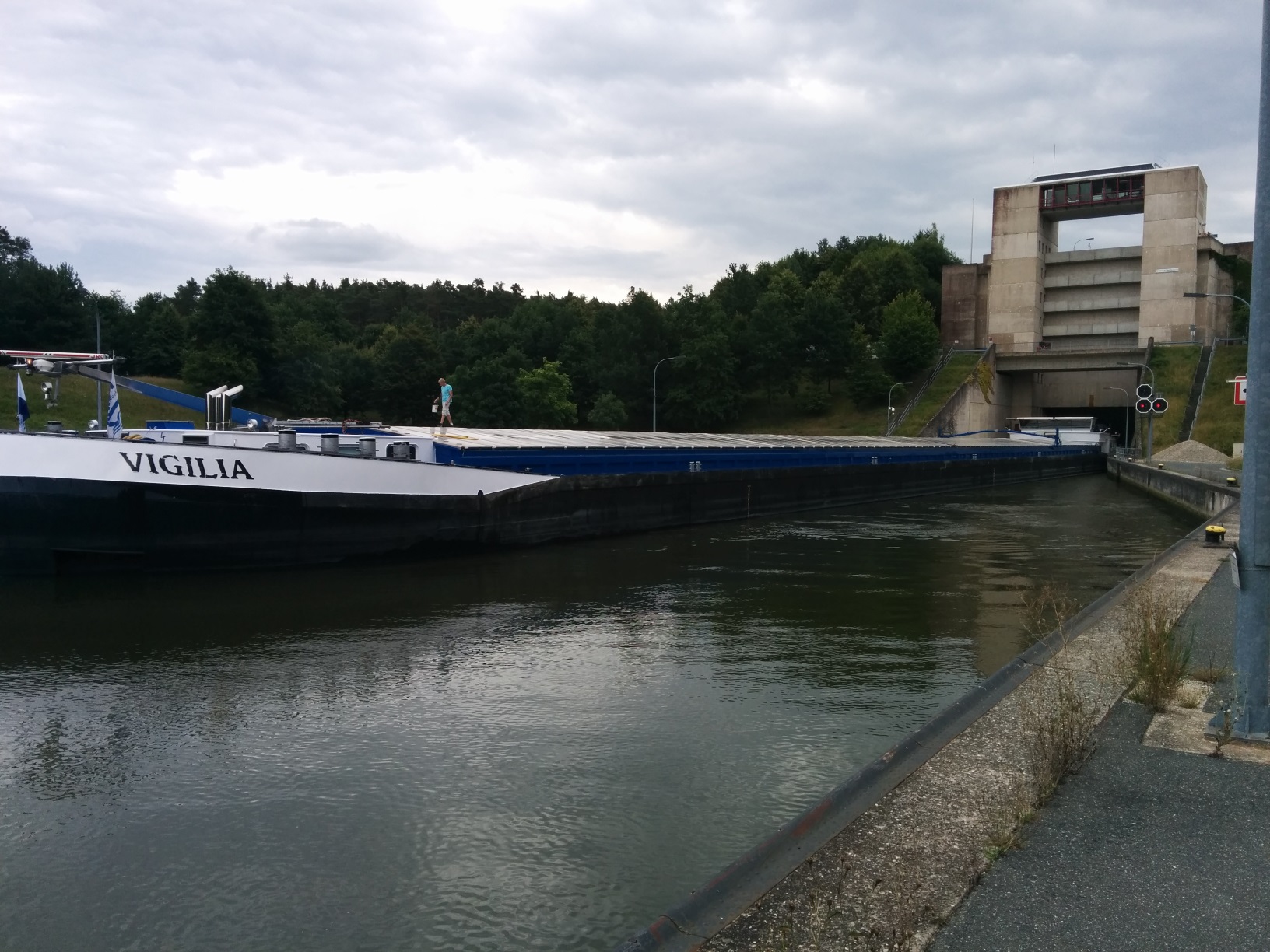
As I may already have mentioned, the barges travelling the canal can be up to 190 m long and 12 m wide. That is big. What I hadn’t realised from the road is that the lock drops the canal by a staggering 25 m (near enough 80 feet). We were lucky enough to catch a big barge negotiating the lock, and the builders of the lock were kind enough to provide a viewing platform. It would have been rude not to watch.

Approaching the top lock gate

We missed the barge entering the lock but saw the top lock gate rise up from the canal behind the ship’s stern. This was clearly not like any lock I’d ever seen before.

We quickly walked down to the far (lower) end of the lock and had to climb several flights of stairs to reach the viewing platform. By the time we got there, the lock was already half empty and we were staring down the dizzying sides at the slowly descending barge.

It looks like a toy in this photo, but this 190m long barge is dwarfed by the scale of the lock

Eventually the lock was low enough and the lower door opened: The entire steel lower section – probably 50 or 60 tonnes-worth of steel – lifts up on chains providing a gap just large enough for the barge to fit under.

The barge emerges from the lock. The man on the front of the barge provides some idea of the scale.

For the technically-minded, here are some details of the lock:

  • Dimensions: 200m x 12m (useable width) x 24.75m drop
  • Water volume: 60,639 cubic metres
  • Water usage per navigation: 24,698 cubic metres
  • Water level rise/fall rate: 1.5m/minute
  • Built between 1980 and 1985.
  • First used (when the canal opened): 1991
  • Time to negotiate: 25mins

Unlike locks on our canals at home, where water must always be pumped up to the highest level and all the water from the lock is allowed to flow out of the lock (and is therefore “lost”), this locks preserves most of the water from each use by a very clever system of emptying it successively into 3 huge adjacent storage tanks set at varying heights corresponding to the water-level heights in the lock. This way, water can flow under gravity from the lock into the highest tank first, then – as the lock level drops, the top tank is sealed and water can then flow under gravity into the middle storage tank. Similarly for the 3rd (lowest) tank. When the lock is being filled, this whole process then runs in reverse. By this means, most of the water per navigation is preserved, and minimal energy is required for pumping. Clever stuff.

Sleep was disturbed by a family with 2 kids & 2 dogs who’d parked very close by: To be fair, they weren’t particularly noisy but a group of people 5 metres away chatting and laughing into the night when sound travels easily is a bit annoying.

Time to move to Brombachsee…

Heiligenstadt, Bayern

Sat /Sun, 9th/10th Aug.

You may have noticed a particularly beery theme developing over the last several days? Time for a change.

On the town map of Bamberg, there is a Mountain Bike Centre highlighted, about 40 mins drive to the East. Whilst we’ve used our bikes a fair amount, we’ve not actually given them any kind of workout on a proper mountain bike type of trail. So after a short drive, we’ve set up temporary home at the Stellplatz in Heiligenstadt – and very pleasant it is too. It’s actually a car park, just inside the town boundary and just off the main road. By the Parkplatz, traffic has already slowed down to the regulatory 50kph within towns. Not that there is much traffic. A few tractors bringing in the grain from the fields and very little else. We’re alongside the Leinleiter – a small  stream at this point, though it does get bigger further downstream. The most noise we can hear is from the stream.

It;s a very small town. There’s a small supermarket, hair-dresser, Bäckerei, Doner Kebab shop and 3 Gaststätte. There are two other camper vans in the car park, also loaded with bikes. The Stellplatz is free, although there are no facilities. Definitely great for a couple of nights.

BONG, went the catholic church bells every quarter-hour. But they had the good grace to stop overnight. Mass at 08:30 on Sunday was preceded by “untuneful cacophony  on four bells”. It was also followed by the ringing of the single bell of the Evangelical church for a quarter of an hour or so. No way was any one of the 100 or so inhabitants going to unknowingly miss the appropriate service.
There was a helpful mountain bike route sign by the car park, showing 3 different waymarked trails of 32km, 44km and 56km lengths. To be honest, I didn’t have any great expectations of any of these being really fun rides (i.e. lots of twisty singletrack, technical bits, interesting descents – the sort of features you get at any Welsh mountain bike centre) as my experience is that trails in Germany tend to be on the longish, steepish climbs, not very interestingish side.

Heiligenstadt MTB trails. We did Route 3 – Matzenstein.

Joy was a bit concerned about the length of the (32km) trail, but the map clearly showed any number of places where we could take a short cut. With a photo of the trail map on my phone we set off.

It was indeed steep. The first couple of kms of climbing were a bit brutal, but most of it was on road or Feldweg (roads between the fields that are often asphalted). It then evened-out a bit but without any exciting bits.

The most interesting bit was a steep descent down what we felt was a truly ancient valley in the forest, with moss-covered bare cliff faces to our side. One could imagine ancient peoples having lived and died here [I’m reading an interesting book at the mo called “The Old Ways”. It’s about ancient paths and byeways, both on land and sea (marked on charts) with a slightly lyrical premise of the path or trail holding a memory of people’s passing that can be felt down the ages].

In the ancient woods

This steep descent marked 3 things:

  1. We’re right by Veilbronn, approximately half way point, and
  2. It’s lunchtime, and
  3. There just happens to be a convenient Gasthof.

Mountain Biking and big meals don’t normally go together well, and this was no exception. We ate too much. We didn’t intend to – ordering one starter and one main between the two of us – it just turned-out that way.

When we resumed the trail, we found that we were hitting the steepest climbs of all on a full stomach. Needless to say we didn’t exactly fly up them.

The rest of the trail was pleasant enough, but pretty uninteresting and we were glad to get back to base.

That night, another thunderstorm with accompanying downpours caught up with us, and I lay awake for some time wondering if the Leinleiter was going to overflow. Needless to say it didn’t!

Bamberg, Day 4

Fri, 8th Aug.

4th day of our 2-day visit, and I’m in no hurry to leave.

Joy wants to visit the Dom (cathedral). I want to visit the Brauerei Museum, so we go our separate ways for the morning.

The museum is at the top of Michelsberg; one of the 6 hills of Bamberg, and “a bit of a climb” on the bike. It’s absolutely crammed full of breweriana, but there’s no real explanation for most of the artefacts. I was hoping there’d be more about the history of brewing in Bamberg, but I was disappointed by its absence.

The Eiskeller in the Brauereimuseum was interesting: this is a cylindrical structure, three stories down – literally in the Keller (cellar). Its walls are about 3m thick, and it’s about 10m tall with a spiral staircase running down the walls (like a lighthouse). The breweries used to need ice in the summer in order to chill the fermenting wort to slow down the fermentation, and then to store the wort/beer for up to 6 months at a low temperature (lagering). In the winter, they’d chop out large chunks of ice from the frozen river Regnitz, and store them in the Eiskeller, gradually filling it for use in the summer.

I don’t know what size this cask is, but it must be well over a Hogshead (54 gallons). To get through one of those in the 3 or 4 days before it would start to go off requires some serious drinking commitment!
Now those are what I call proper Bierkrugs!

There was a showcase full of bottled beers: one shelf for German beer, the row below being for “Beers of Europe”. Note the Boddington’s bottle.

Beers of Europe?

Note also, however, the bottle of Budweiser next to the Boddy’s: This is a bit anoracky of me, but I’m afraid they cocked-up. That’s a disgusting American Budweiser brewed by Anheuser Busch. It’s NOT the proper Budweiser Budvar Brewery (Budějovický Budvar) in the Czech Republic that it should be. That man on the door was so uncommunicative and unhelpful, I didn’t trouble him with this information.

I decided I needed a beer after the museum, and I wanted to visit the Gasthof Kachelofen to try the St Georgen Buttenheimer Kellerbier on their menu. I was far from disappointed. Joy met up with me in time for a refill before we set out for Brauerei Mahr.

Mahr is a little way out of the town centre. We got there at around 5pm, and had to camp out on someone else’s table. It was absolutely crammed, almost entirely with locals. Ok, the inside rooms were closed – no need for them as it was a pretty hot day – but that still left a couple of hundred people sitting outside. We asked how it was in the winter and were told it’s just the same, only the inside rooms were in use. What a wonderful business these breweries enjoy.

Mahrs beers also come highly recommended, and the gemütlichkeit (roll together the English words “atmosphere” and “congeniality” for a reasonable translation) makes this one of the best Gaststätte in Bamberg.

Mahrs Wirtshaus inside
…and outside

All good things must come to an end, so after we’d had our fill of food and drink, it was time to say au revoir to Bamberg as we wanted to move on towards Nuremberg.

Bamberg, day 3

Thur 7th Aug.

This is the 3rd day of our proposed 2 day visit, and it’s going to be a beer-free, bike-touring day (perhaps!).

Bamberg is a wonderful town – UNESCO-Heritage listed. It’s also small enough to be able to get around by foot or by bike.

I lost track of which Mühlbrücke this was (there are several of them!)
Little Venice
The Alte Rathaus

We want to have a leisurely bike ride around the area, taking in an Edeka supermarket along the way (see previous post about Internet Woes!). I *thought* I’d seen an Edeka near the “other” Stellplatz in Bamberg – the one we couldn’t get into because it was full. I was obviously mistaken – not an Edeka in the area.

But we did come across a nature reserve underneath the main road junction. At least a part of the reserve was there though it did extend beyond. Well beyond. A thoughtfully located map provided us with directions for a ride along the left arm of the Regnitz (the River Regnitz splits into Left & Right arms just to the South of Bamberg). So we followed the Regnitz, taking in the bathing area (pass on that) and the cafe (noted for Kaffee und Kuchen for later in the day). We soon found ourselves back in Bamberg despite the fact we thought we were heading in the opposite direction. Never mind – time for our sandwiches by the old lock before heading South once again.

We headed back S along the Regnitz for several miles, eventually reaching a village called “Bug”. Silly English humour I know, but I couldn’t resist taking photos of the Hotel there – The “Buger Hof”!

Hotel Buger Hof

We crossed over from the Regnitz and cycled over to the aptly-named Main-Donau Kanal. This is – as you might well imagine – a canal that joins together the rivers Main & Donau (or Danube, to most Brits) and thus provides a navigable route all the way from the Black Sea into the North Sea. This is not a canal like (say) the Leeds-Liverpool canal. It is a modern (built 1980 – 1992), mighty, wide, deep & long piece of construction engineering, designed to take ships (barges) up to 190m long and 12m wide.

As we cycled up to the raised banks, an enormous hotel ship passed by heading North towards Bamberg. We cycled to the South, going for several miles further before we came to the mutual decision that  – actually, it’s pretty flat and boring. So we turned around and headed back to the cafe we’d noted earlier for Kaffee and Kuchen.

Whilst we were in Bug, I spotted that increasingly rare object – a phone box. Even more unusual was the set of phone books hanging from the rack in there. Ah-ha – might there be an Edeka listed in there? Out of the five books hanging in there (all of which I was slightly reluctant to touch without rubber gloves!), I managed to find one who’s form of listing I could understand. And – yes; there’s an Edeka listed in it. It’s outside of Bamberg and not exactly on the way home, but worth a detour to get a phone top-up.

Bamberg, day 2

Wed 6th:

It’s our wedding anniversary. To celebrate, we decided to cycle into Bamberg, drink a few beers (possibly), and have a meal. Sounds a bit like last night, in fact.

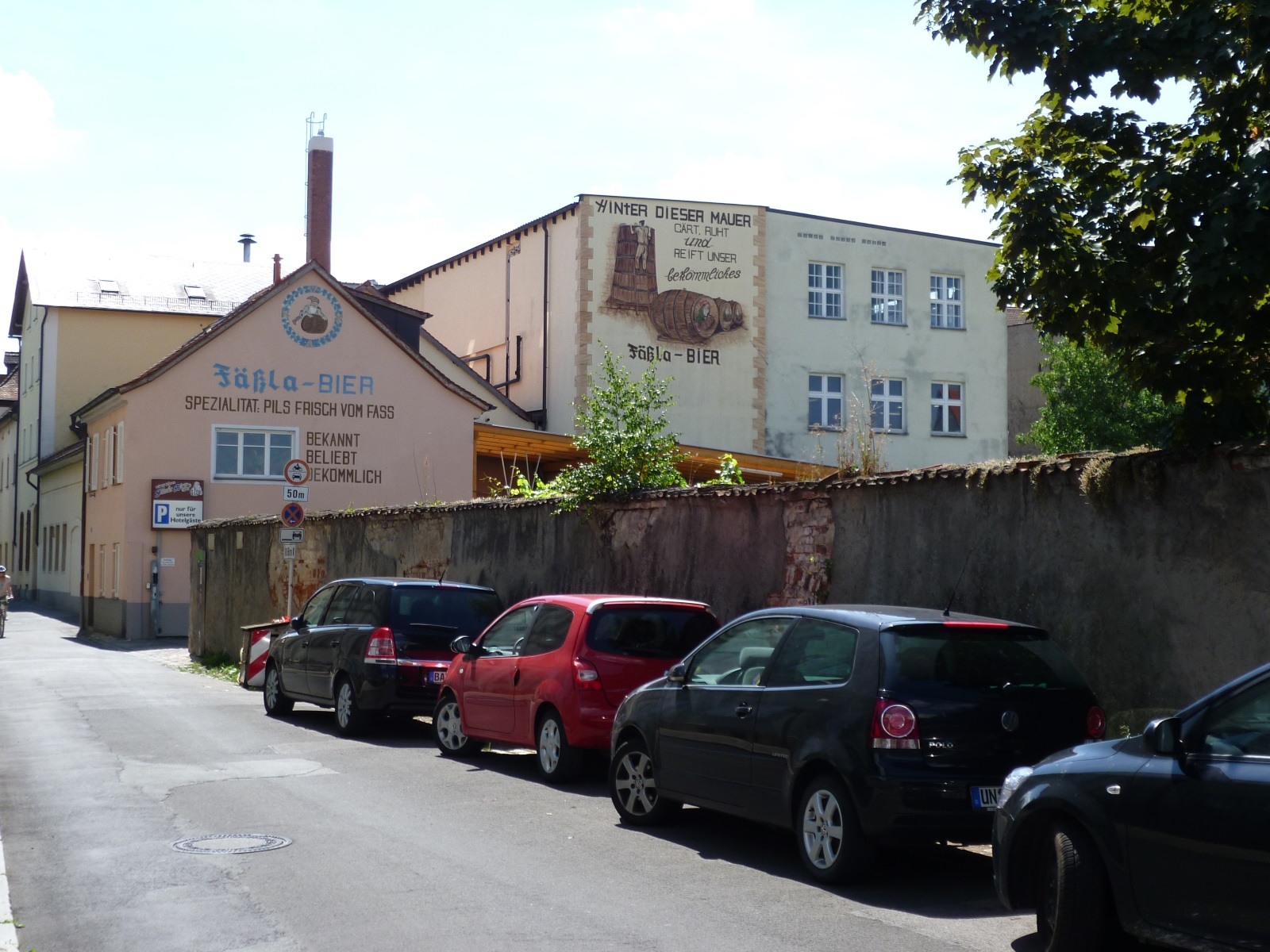
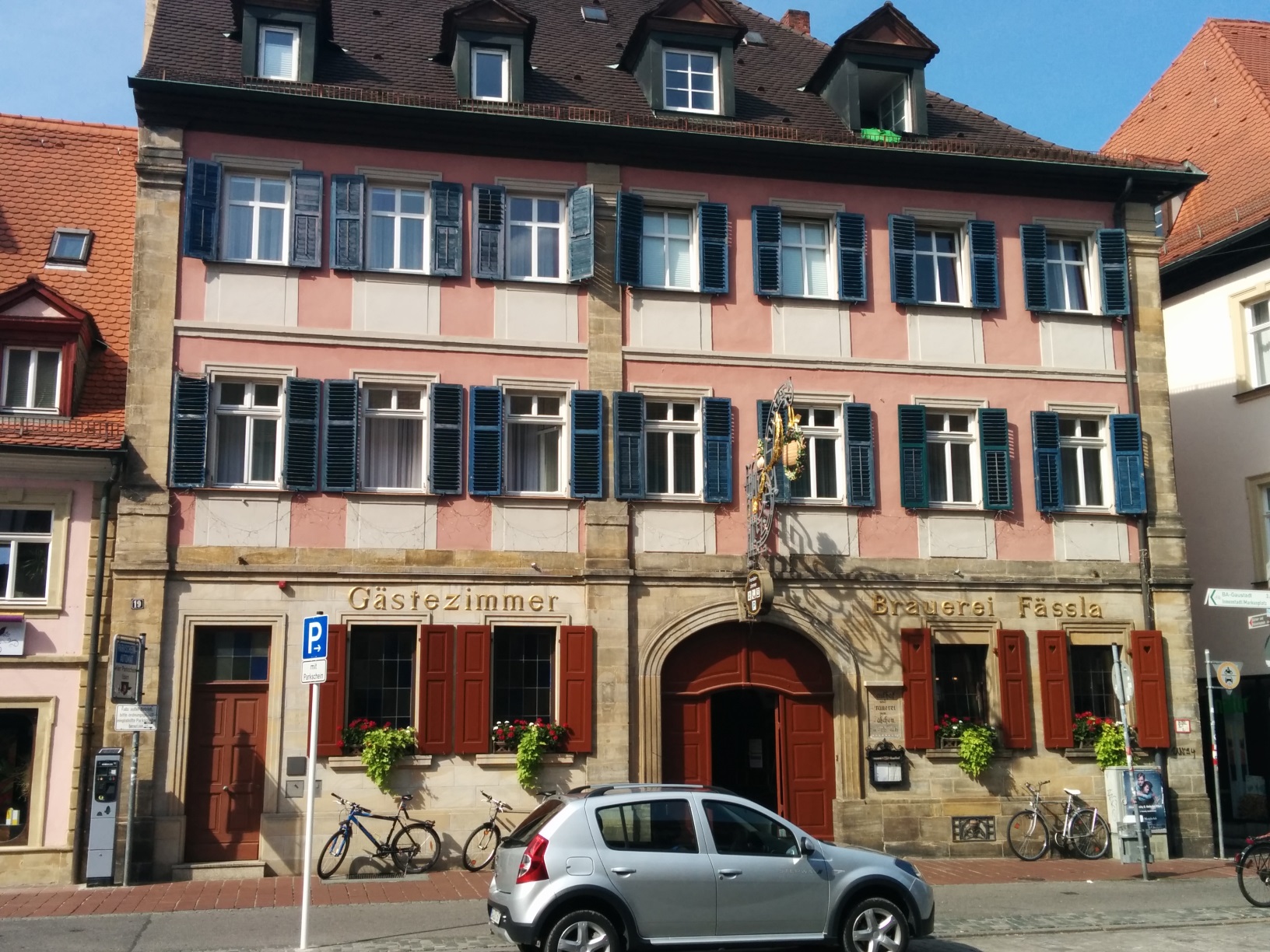
We started off at Brauerei Fässla – simply because it was right alongside the bicycle alley leading onto the Königsstrasse. Again, no problem taking our bikes down the entrance and into the Biergarten/Atrium. I tried the Zwergla – a dark, rich, 6% Märzen.

The first sighting of Fäßla from the cycle route
Brauerei Fäßla

One of my main reasons for wanting to come to Bamberg was for the Rauchbier (literally smoked beer). Bamberg is famous for Rauchbier and there are very few other places in the world, never mind Germany, where it is made. In fact, there are now only 2 breweries left in Bamberg that still produce this style.

It may sound weird, or even unpleasant, but Rauchbier often has a “bacon-like” smokiness flavour with sometimes a peppery finish to it that comes from the smoked malt used for brewing.

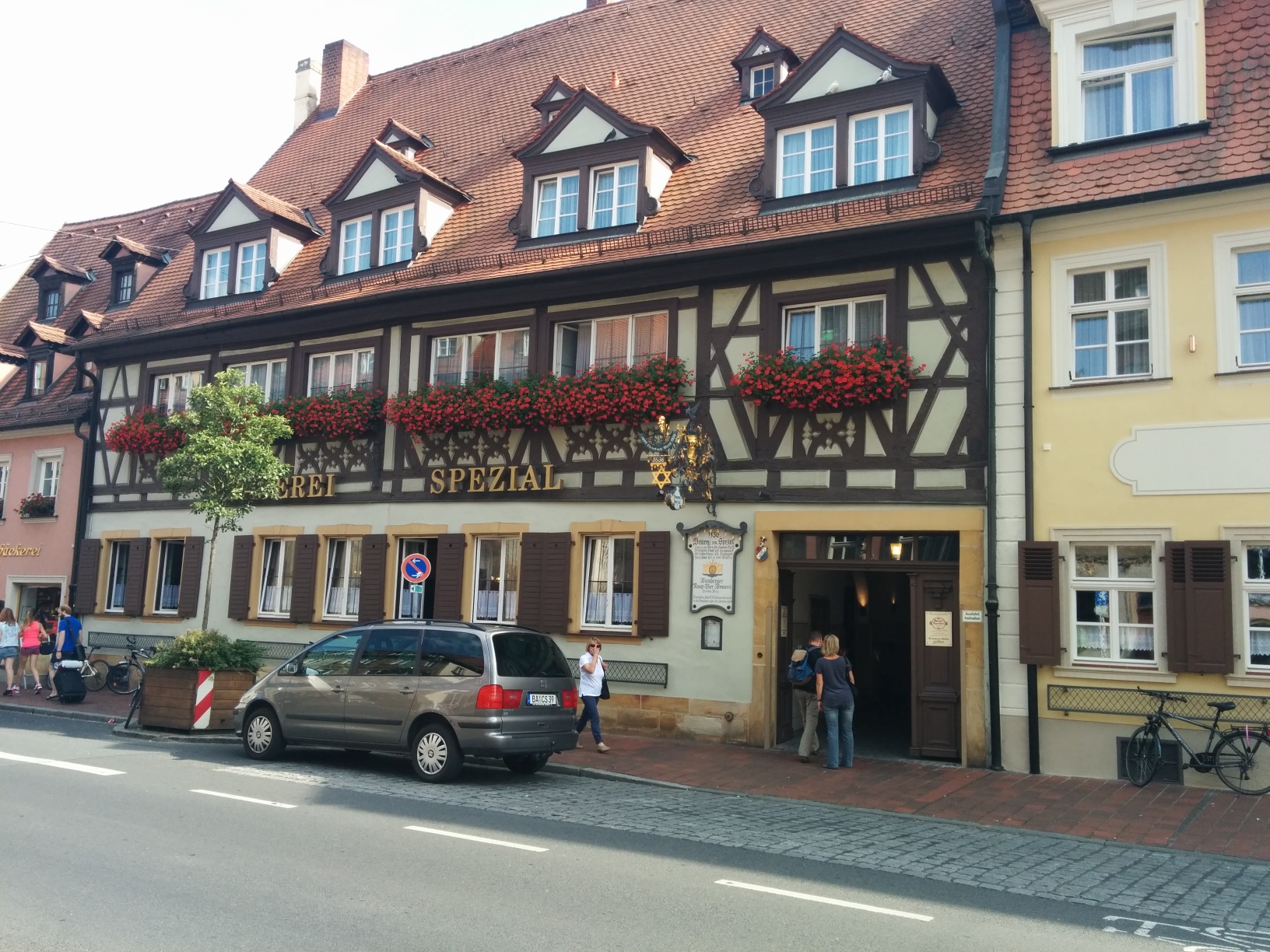
The first Rauchbier Brauerei I had on my list was Brauerei Spezial. It had to be close by Fässla as the street name was the same. In fact, it was on the opposite side of the road. Directly opposite. No more than 15 metres away. Fall out of one into the other if you’re lucky enough to avoid being run down by bicycles and cars.

Brauerei Spezial

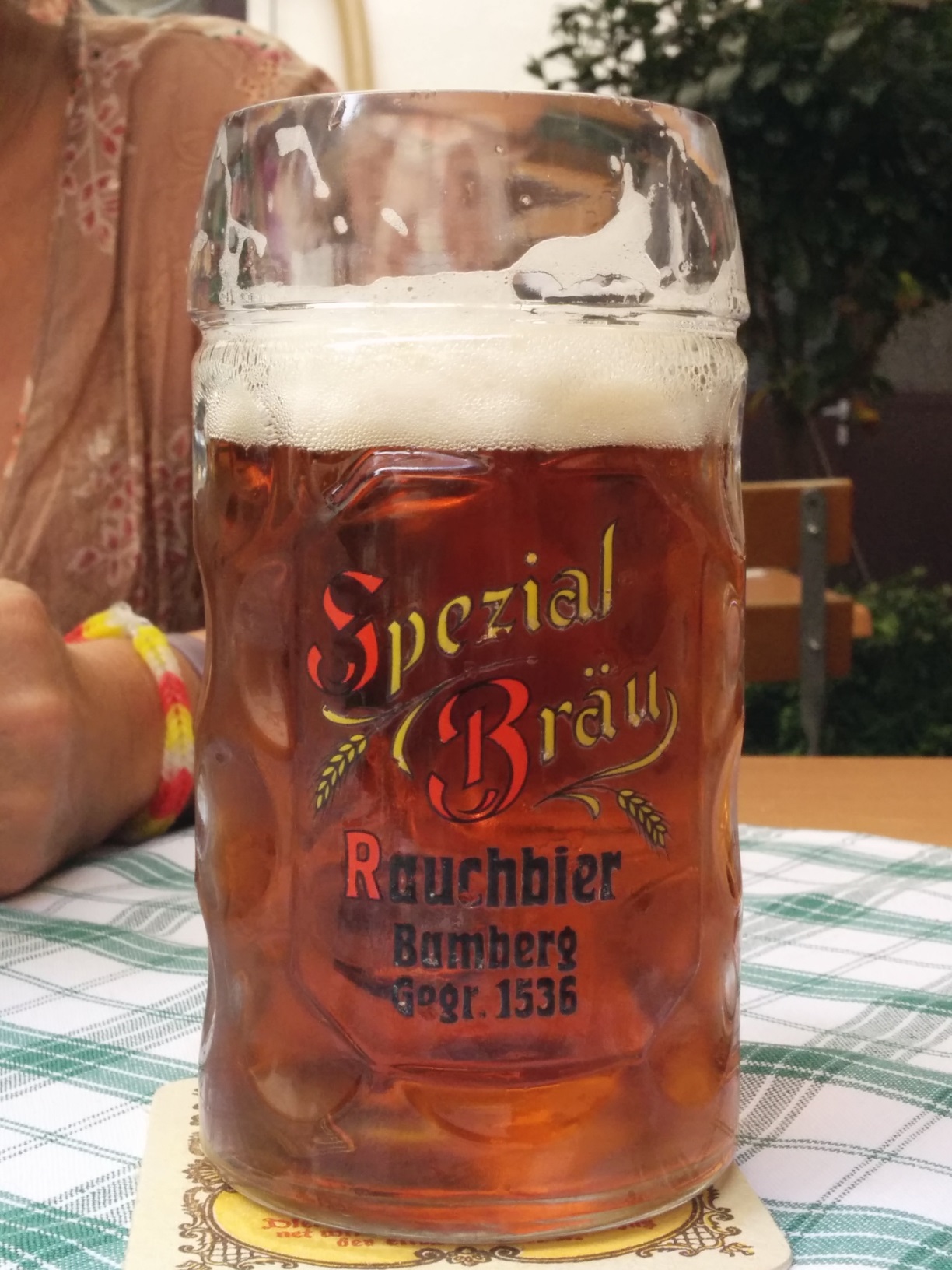
First up for me was the Rauchbier Märzen – a 5.3% smoked dark lager. Well-hopped (again, this is feature of Fränkische beers compared to those from other parts of Germany), with smoky and toffee flavours. Most excellent.

Rauchbier – you can almost taste it from here!

Joy then departed to do some window shopping, and a local joined me at my table. So I had to have another beer just to be sociable. This time, it was an “ungespundetes” (unfiltered) 5% lager. Naturally cloudy, with malt, coriander, and woody flavours. Had a long chat with the local who was telling me all about the maltsters of Bamberg: there are two of them, both with large maltings supplying not just Bamberg, but the whole of Germany. Some of their malt makes it to the UK, apparently.

Time for the next brewery – Schlenkerla. This was a 5 minute bike ride away in the Altstadt, but was most definitely worth it. Again, I was able to park my bike in the Biergarten. This time however, I was unable to find anywhere to sit. It was crammed. I did the German trick of inviting myself to sit on someone else’s table (which is perfectly acceptable in Germany). As soon as they left, their spaces were seized by several Asians. In fact, when I looked around, the place was full of them. A couple more arrived and I was struggling to keep a space free for Joy.

Schlenkerla

Over a Rauchbier Weizen (a most unusual and extremely hard to find beer), I got chatting to the Asian couple who turned out to be Chinese, and from Canton. They were really friendly, and wanted to tell me all about their 11 day tour of Germany (including Füssen, Garmisch-Partenkirchen and Munich in one day). They’d visited England last year but – apart from London and Bath – couldn’t recall where they’d been. Only that they found it very, very expensive (so do I). When their party left, they insisted on taking a photo of me!

In the meantime, I’d started on the Rauchbier Märzen – at 5.1% and probably the best German beer I’ve ever come across. When Joy arrived from her shopping expedition, I had to order another to go with our food. I’m not entirely sure what I ordered, but it seemed to be Bratkartoffeln mit kleine pieces of Schweine. It was exceedingly good.

I’m guessing we left at something around 7:30, and the place was still heaving. As were all the other Gaststätte we passed on the way back to Memmelsdorf.

This is a place I’ll definitely return to in the future.

Bamberg

Tue 5th:

Her at  the top of the windscreen has done it again. About 1km into the (shortish) drive from Würzburg to Bamberg, we hit another Umleitung (diversion) in the middle of town. Off we went on a jolly detour. We were doing all right until she said something like “turn off left then stay left”. I did, but there was another “left” exit immediately following, and the lane I was in peeled-off. Wrong. So she quickly recalculated, and we followed her revised route. In completely the wrong direction again. My theory is that she gets the hump at us not following her every wish & then takes us on a wild goose chase to get even.

Instead of going East towards Bamberg, we were taken some way North and onto a completely different road to that which we’d planned to take.

Anyway – enough of that. We stopped for a bite to eat in a tiny place called Ebrach; just catching the bäckerei before he closed for lunch – he really didn’t seem pleased to see us. It turned out that Ebrach has a 12th century monastery and abbey, with wonderful gardens open to the public. It also has a 16th century orangery – now turned into floral gardens with a central fountain, and a 16th century wine and beer cellar – unfortunately not open. It also boasted the most scrupulously clean public toilets I’ve ever seen, in gleaming stainless steel, complete with electronic sensors to automate anything could atomated and more besides. It also had the most stupidly designed urinal I’ve come across for a long time (albeit fantastically clean). These are housed in what was part of the wine cellar. Obviously the designer believed the ordinary male to be vastly more well-endowed than is really the case, with the result that the floor gets more use than the urinal. This probably explains why the floor had that “just-mopped” look about it, and it was scrupulously clean. I wonder if there are some robots that pop out of some 16th century hatch and mop the floor when there’s no-one looking?

I was pretty fed-up with “windscreen woman”, and hate her dubious pronunciation of German place and street names. So I switched to a German voice to see if the German woman was any better.

We got to our chosen Stellplatz by the park & ride in Bamberg with no further problems. Except that it was full. Pity, because that one was only 15mins walk into the old town. But it WAS by a P+R (Park + Ride), it WAS pretty cramped, and it looked like it might get noisy. A quick glance at the Stellplatzführer revealed another possibility, though it was about 6km outside Bamberg in a small town called Memmelsdorf. We drove round to there: it seemed perfect. A corner of a large car park of the Sportshalle set aside for motorhomes overlooking a brook and with some trees for shade, with the playing fields (unused in the summer) beyond. And there was space a-plenty.

It was 15:30. Time to get the bikes out for a quick trip into Bamberg. First impression: Bamberg is set out for cyclists. Big time. Cars stop at junctions if the bike lane crosses the junction and there are cyclists on it. This took some getting used to as we thought we’d just get mown down. Not a bit of it. The drivers are SO aware of bike lanes crossing road lanes, and bikes certainly seem to have priority just about everywhere. I wonder if we could introduce that as a concept in the UK? The bike lanes where they exist – are also completely clear from any “street furniture” e.g. trees, bus shelters, railings, parked cars, lamp-posts. However, cyclists are also expected to obey the cyclist traffic lights which are fairly common in the town.

We were heading for the Tourist Information office; hopefully before they closed (it takes a good 35 mins into the centre of Bamberg from Memmelsdorf). Fortunately, there are big Info Points (aka “Maps”) all over the city but we still managed to get slightly lost!

The TI office was able to provide small town plans. Thus armed, and with a list of pubs and breweries I was hoping to visit, we alighted at Brauerei Klosterbräu. This was the pub/brewery on my list that’s closest to the TI!

Time to test the Klosterbräu Schwärzla – a black lager. It passed the test. Several times, in fact. Well, it was a very warm day.

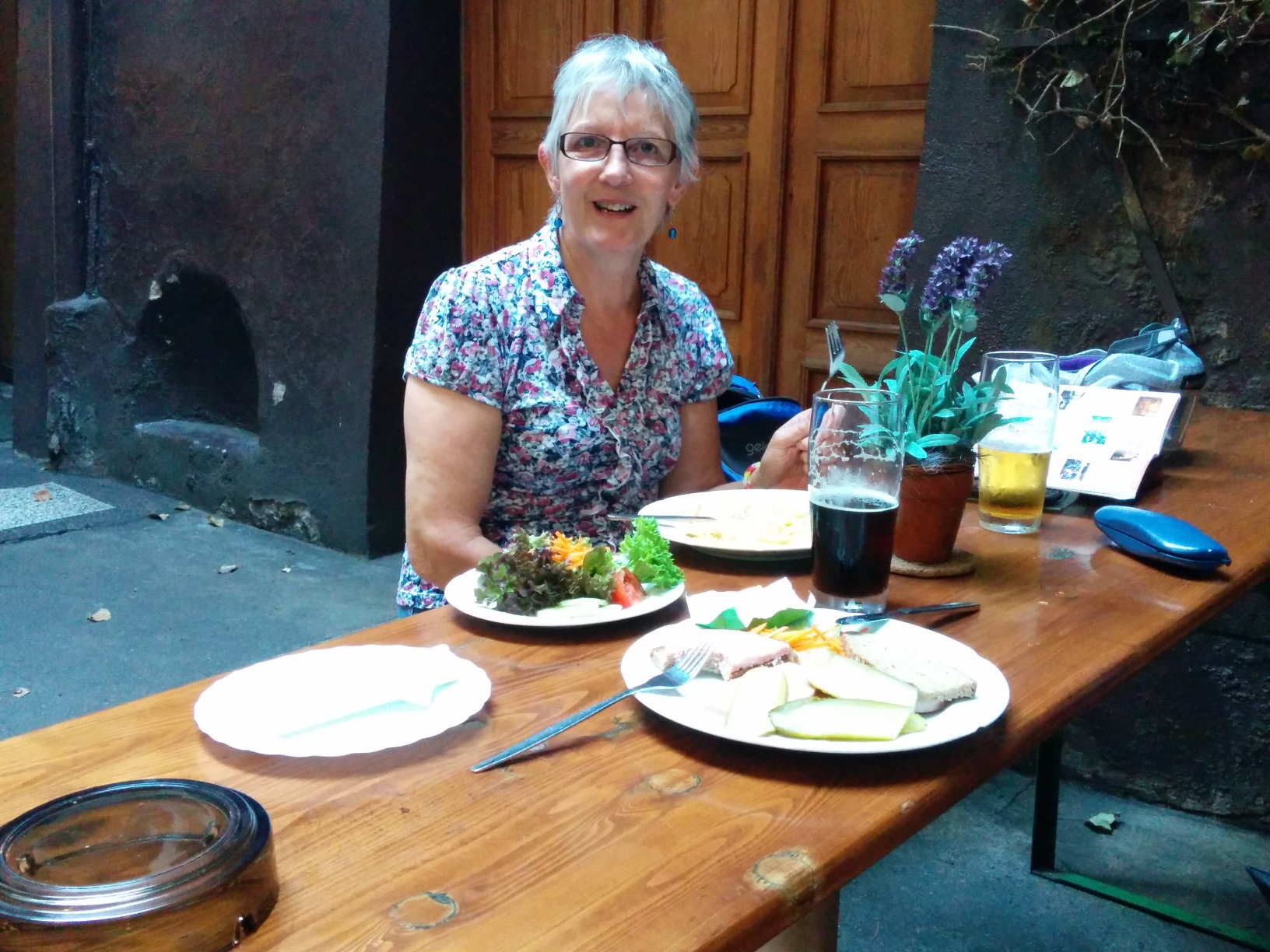
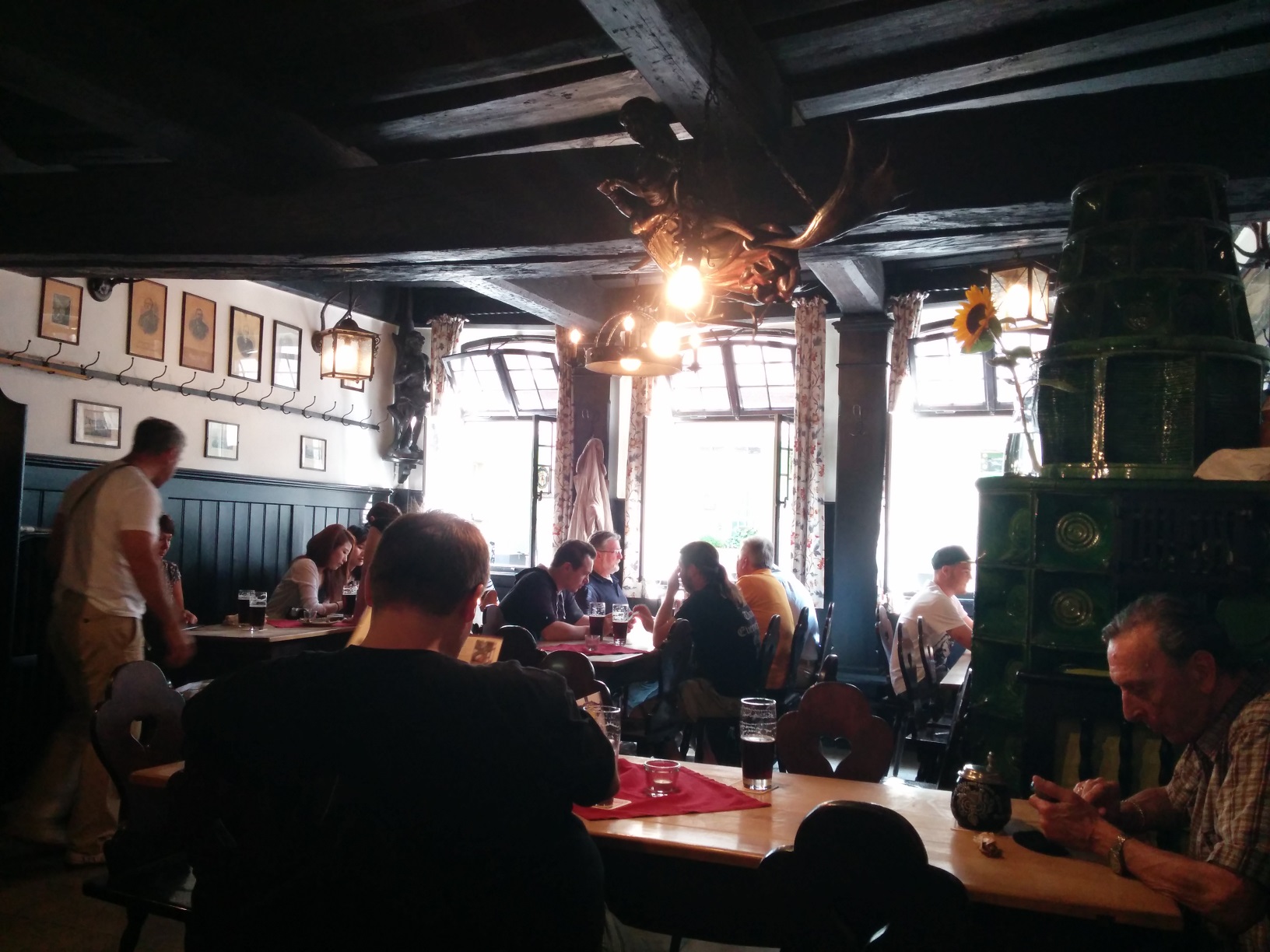
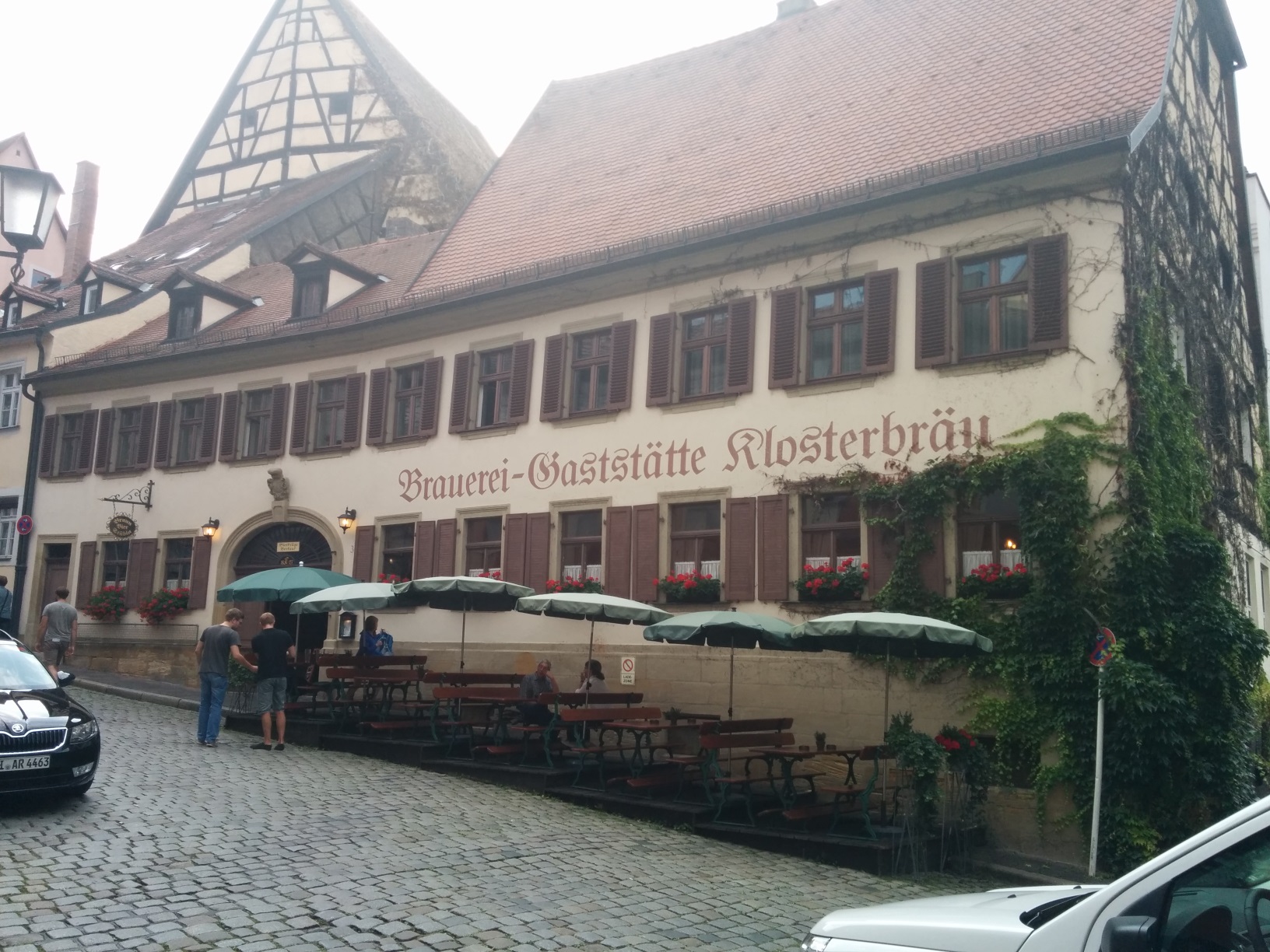
Brauerei Klosterbräu was really an introduction to the fantastic fusion of Gaststätte, breweries, and history seen all over Bamberg. It is a working brewery – the oldest in Bamberg (founded 1533) – producing no less than 9 different beers. It’s also a fascinating building with an ancient passageway leading to an atrium – where we sat and had a meal. Not just Bayerisch food, but Fränkische food. I barely understood a word of what was on the menu, and I consider myself pretty fluent in German.

They were completely unfazed by us taking our bikes into the pub – never batted an eyelid. Must be common here. By 6 pm, there was barely a seat left in the place, neither inside nor outside. Great atmosphere and friendly staff.

Klosterbräu
Cheers!