Colds, diversions and Würzburg

Mon 4th Aug, 2014

It’s time to leave Ehningen and head off towards Bamberg by way of Würzburg. It’s reassuring to know that the girls’ capacity for passing-on colds and viruses is still undiminished. Both Joy & I have sore throats. Kathryn also had a cold whilst we were there and had also lost all senses of taste and smell. This is a worry as we’re planning to visit a number of breweries & Gasthöfe in Bamberg and having no sense of smell or taste will do little to enhance the experience.

Having – or so we though – plenty of time to get to Würzburg, we set our guiding light (the SatNav, or “she”) to avoid motorways and take us via Schwäbishe Hall. We’d also heard on the radio that the stretch of the A8 Autobahn we would have needed to use had become a 10km long parking lot this morning and therefore well-worth avoiding.

The plan got us as far as Leonberg – about 12km. In Leonberg was an Umleitung (diversion) which is always good for throwing our SatNav into a spin. I made the mistake of following the SatNav which then took us along a narrow street, via a couple of right turns, eventually ending up at the point where we’d been diverted from the main road in the first place, only now with no option but to turn back towards from whence we came. Bless her, she’d brought us back onto the chosen route the shortest way possible which – had there been no diversion, would have been just fine. Leonberg is not an easy place in which to turn around, so we decided to (temporarily) abandon our aim of avoiding motorways – having got beyond the traffic jam – and jump onto the A81 for couple of junctions.

We followed the signs for the Autobahnen A8, A81, travelling several miles BACK along the route we’d driven earlier. This was unexpected. We eventually came to the A8 junction which was still suffering traffic chaos. I managed to avoid getting onto the Autobahn by swerving into a road where the sign was pointing to the Leonberg industrial area. So we then did a tour of the industrial area before ending up back in the town, exactly where the Umleitung was.

This time I was going to ignore “her at the top of the windscreen”, and follow the signed diversion route. Hooray! We then followed a bizarre route taking us miles out into the countryside in completely the wrong direction. I decided to listen to “her of the route” again. She continued to take us in the wrong direction.

Several sense of humour failures and threats to throw her in the bin later, we’re about 1 ½ hrs later than expected with a surplus 35 miles or so on the clock. But we were on the right road. Or at least, a road that would eventually bring us back to our road of choice.

We arrived in Würzburg at about 3pm, our SatNav having redeemed herself slightly by taking us to exactly the right spot, first time. This was a large Stellplatz right on the bank of the Main, just 10 minutes walk into the old town. It was also a car park and bus park, so pretty busy. We could watch the barges coming and going towards the lock gates just 500 metres upstream. Some of these barges were huge. Some were even huger as they were – in effect – one barge pushing another in front. To try to put this in perspective, each of these barges was about 2/3 the length of a football pitch. As you might imagine, it takes quite a lot of heavy diesel engine power to push that lot along against the flow of the river.

We took a stroll through the town centre – another fabulous town where everyone hangs out in the many bars and cafes in the balmy warmth. Wonderful atmosphere.

After a brief stop for a bier at a riverside Gasthof, it was back to the van for dinner. The Dutch people in the van next to us had set up their table & chairs right in front of our van. Maybe the view of the river was better than it was 3 metres to the side. Their side. Who knows?

Whilst we were eating, there seemed to be a lot of shouting and swearing from underneath the road bridge – also passing over the Stellplatz – about 50 metres away. Then a loud radio started up, seemingly from the same source. At 9pm, the rock concert at the previously unnoticed stage at the far end of the park started up in competition with the loud under-bridge radio. The radio never stood a chance. Although the music from the rock concert was pretty good, it was certainly no cure for insomnia. Fortunately, the German law forbidding loud noise in public places after 11pm was adhered to and the concert ended bang on cue. The barges didn’t (at some point in the night, the van was resonating to the heavy engines of a passing barge). Neither did shouty-loud-radio-man (who, it turns out, seems to have adopted the bridge as his home). Sleep for me, was not plentiful. A pity, as it was otherwise an excellent location.

In the morning, with “her on the windscreen” programmed to take us to another Stellplatz in Bamberg, we’ll set off for who knows where…

[update – 12th Aug: No photos, I’m afraid. Internet connections have been so poor that I can’t get them uploaded. They will follow in due course…]

More Internet woes

8th Aug, 2014

I’m sitting here in the van stripped down to a pair of shorts (sorry – probably too much information!). It’s 21:30 and 29°C and I’ve just taken a shower after the 7km bike ride back from Bamberg. I’m waiting until midnight’ish before I can go to bed because the electricity supply arrangement on this otherwise good Stellpatz, is €1 for 8hrs worth of supply. All in all, not a bad deal on the face of it. You could power a blast furnace if you wanted to, but only for 8hrs. All I want to do is charge the laptop, smartphones & tablets. The solar panel on the roof will bring the van’s leisure battery back up to full power by mid-morning, so I don’t even need to rely on the mains supply for that.

Our fridge will happily run from any of  – gas (running a little low until I can get to a petrol station that sells LPG); 12V (when the engine’s running); or from mains power. But it’s dumb insofar as it won’t automatically switch to whatever supply is available – it needs a human (or trained monkey – but they’re in short supply) to switch it to whatever is the preferred energy source. It runs most efficiently from mains and – as I might have mentioned – the gas is getting a little low.

So if I were to insert my €1 now and switch the fridge to mains supply (and plug in all our devices that need charging), I’d need to get up at 05:30 when the mains switches off, to either…

  • Get up, go outside and feed the machine again, or
  • Get up, switch the fridge to gas.

Either way, I’d be getting up at 05:30. 05:30 is a perfectly nice time. I have nothing against 05:30. I just don’t want to get up at that time. So I’ll wait until midnight, feed the machine & then get up at a slightly more sensible 08:00 to switch back to gas.

All of this is by way of suggesting that not everything in Germany is perfectly thought out and executed. They may not be the masters of the universe in all respects.

The problem with 8hrs mains supplies however, pales into utter insignificance compared with the utter backwardness of public Internet availability. Maybe we’re spoilt back in the UK, but it seems to be de-rigeur these days for just about every pub, library, cafe, restaurant, swimming pool, coffee house, service station (at cost, of course) et al to offer free WiFi Internet connectivity, albeit often of dubious quality. But at least, it’s available. In Germany – the most technologically advanced country in Europe, where even most urinals automatically flush themselves after your passage – my phone has failed to pick up a single WiFi access point – free or secured. Nada. Nichts.

This has meant that researching one’s next stop is impossible. Even checking the bus or train timetables can’t be done. Not to mention updating this blog. All that is taken for-granted back home. If you don’t have internet connectivity, you’re doomed to the dark ages (and missed buses). So I had to look for ways of getting some kind of mobile Internet access…

My mobile provider back home (T-Mobile) does offer a roaming data tariff whilst abroad. It used to cost £3 per 100MBy per day – which actually isn’t such a bad rate, and I have used it a couple of time. Trouble is, uploading photos to the blog tends to burn up 100Mby fairly quickly – and that’s after I edit all my photos to reduce the size prior to publishing them. Also, last weekend when I decided I needed something better, T-Mobile was saying (on my phone) that there were no further optional “boosters” (as they call them) available to me., until I got a marketing text message from them on Monday offering a new service of £3 per 50MBy/day or £5 per 100Mby/day, or £15 per 500MBy for 7 days. I.e. pretty much a doubling of costs, so they’ve excluded themselves from the competition.

Now researching smartphone Internet deals is pretty difficult with no Internet access. However, during the brief pre-burn-up time of my 100Mby, I managed to find a blog all about mobile phone Internet providers in Germany (in English!). One of the (apparently) best deals is offered by a German supermarket chain – Edeka. €9.95 for 500Mby in 30days. So I bit the bullet whilst in Edeka in Ehningen, and bought myself an Edeka SIM card for €10 that allegedly had €10-worth of credit on it. It uses the Vodaphone network here in Germany which – allegedly – is about the best (sorry about all the “apparently’s” and “allegedly’s”).

I eventually managed to remove the SIM card from my Google handset (the tool for this is at home, of course) and insert the Edeka SIM card. Now I’ve never had a pre-paid tariff before, so am very naive with how these things work. Add to which, all the instructions were (understandably) in German. I thought I’d managed to figure it out. There’s a toll-free number to call that connects with an automated system to register your new SIM card. The system didn’t recognise the SIM card/phone number combination. Fell at the 1st hurdle. However, the system didn’t give up on me, it connected me with a very helpful (real) person who took the details and assured me that everything was hunky-dory. She also confirmed that the €10 free credit could be used for the data tariff (as opposed to phone calls & SMS messages.

The SIM card wasn’t working: Internet access simply wasn’t available. Back to the free phone number. Ah-ha! There was an option to change my tariff to “500Mby in 30 days for €10”. Done. Within seconds, I received a text message saying that my data tariff would be available as soon as I received confirmation of having registered my “account”. What account would that be? It’s a blasted pre-pay phone. And I was told the initial credit could be used for the 500Mby in 30days bit.

I then noticed that I had an Internet connection. Hooray! But my rejoicing was premature: the internet connection was burning up my “free” €10 at a rate of €0.24/Mby. I.e. the phone, rather than the data tariff. It was gone within 5 minutes.

So now, a long way away from the Edeka I know in Ehningen, I need to locate another branch of Edeka here in Bamberg in order to buy a top-up – this without any Internet connection; I can’t simply Google it.

Later…

We found an Edeka yesterday after a long bike ride on a mission. And they sold top-up cards. Guess what? The top-up cards are either €15 or €25. How does that work with my €10 per 500MBy per month tariff? No-one was able to explain.

Last night, I registered my top up, set up my phone as an Internet access point for my laptop, and wrote some stuff for the blog (not yet published). At midnight (see earlier electrical supply discussions), I went to bed.

This morning – just for a laugh, and because it’s a toll-free call – I called to check the balance on my account. They don’t tell you how many MBy you’ve used or have left; they tell you how much monetary credit you have left. €2.30 in this case. That’s equivalent to having used 375MBy within a few hours. Not impressed.

I think that what’s happened is that my laptop – running Microsoft’s mega-bloatware Windows 7 – managed to sneak in a quick Windows security update to supposedly patch yet another gaping security hole in their extensively quality-controlled operating system. Bugger. I’ve now set my laptop NOT to do any Windoze updates. I’ve also told Android on my phone NOT to do any background activity when not connected by WiFi.

That was one expensive Windoze update.

One day, I’ll have it all sorted and be able to tell you all about Würtzburg and Bamberg. Keep your eyes open, but don’t hold your breath. And in case you’re wondering; I write all this stuff offline, then upload it when I’m lucky enough to have a connection!

Nesselwang, and back to Ehningen

Pretzels, Laugenstange & Tafelbrötchen successfully bought, though at 08:30 they’d almost sold out.

I’d said in an earlier post that Nesselwang didn’t seem to have changed much. Actually it has,  but it wasn’t obvious at first. It’s more up-market than it used to be. Although the buildings haven’t changed, the occupants of some of the shops have. The old wine and spirits shop has gone, and has been replaced by a clothes shop selling traditional alpine dress, e.g. Dirndls & Lederhosen. There was a shop dummy sporting a pair of very attractive Lederhosen, but at an eye-watering price of €949. I’ve since been told that’s actually at the lower end of the price range. There are other “sports” clothes shops aimed at the holiday-making alpine walker; all very expensive.

Nesselwang always was a fairly unremarkable ski resort; after all, it’s not really high enough to be “snow-secure”. Notwithstanding that, there’s a new Kabinenbahn (cable car), though – judging from the fullness of the car park at 10:30am – it used mostly by walkers, and & sure it’s a fabulous place to go walking.

Brauerei Gasthof Post. It seems not to have changed at all. I still have a couple of unopened bottles from here that I must have bought in 1986 or 1987.

I enquired whether it was possible to take a mountain bike up the ski lift: Yes, it is. Trouble is, there are no marked MTB trails (only walking trails) and – whilst I’m sure there would have been a good morning’s riding to be had, without a guide, I would probably have spent most of the time going down blind trails and having to push back up, or running down walkers.

We stayed on the Wohnmobilstellplatz in Nesselwang – a rest-stop set-aside purely for motorhomes (cars & caravans not allowed) – lying just at the bottom of the ski lift. It’s a fabulous location, if not a little short on facilities (like loos & showers, though we’re self-sufficient in that department). And at just €8 per 24hr + €0.50 per 0.5KWh of electricity (if you need electric hookup – and we only need it to recharge the laptop – we can run the fridge off gas, and the lights off the spare battery, which gets recharged either when the engine’s running or from the solar panel on the roof), it represents pretty good value for money. Again, I can only marvel at the foresight of the local authorities in providing such facilities, and can similarly only bemoan not just the absence, but the illegality of this, back in the UK where you’re not allowed to stop anywhere without…

  • permission
  • paying vast sums of money
  • being driven bonkers by late-night drug-dealers and/or idiots doing donuts
  • being moved-on/arrested for vagrancy/being a traveller
Nesselwang’s Stellplatz – a pretty scary-looking place (not)
Looking up to the Alpspitz from the Stellplatz.

We left Nesselwang about lunchtime, heading back to our daughter’s house in Ehningen – we had to be back in time for our eldest grand-daughter’s 5th birthday. Again, we decided to keep off the Autobahnen as much as possible, so we headed across the Schwäbische Alb, cutting off a big motorway dog-leg in favour of smaller roads through a million small villages. All went well until we hit the rush-hour traffic in Reutlingen and (less so) in Tübingen.

We’re now here for a few days and the weather has been vile. Thunderstorms seem to have caught up with us again and it’s pretty cool. SHould improve from Thursday.

Next on our travels may be Munich, Nuremberg and Bamberg. Lots of ancient breweries & pubs in Bamberg; not to mention the unusual Rauchbiers (smoked beers) that the town is famous for.

Verona Photos

Lots of fancy balconies in Verona
…though the fabled Guilietta’s (as in “Romeo & Juliet”) is a little more plain. This piazza was absolutely heaving with people, all trying to put something concrete to what was – essentially – a fairy story!
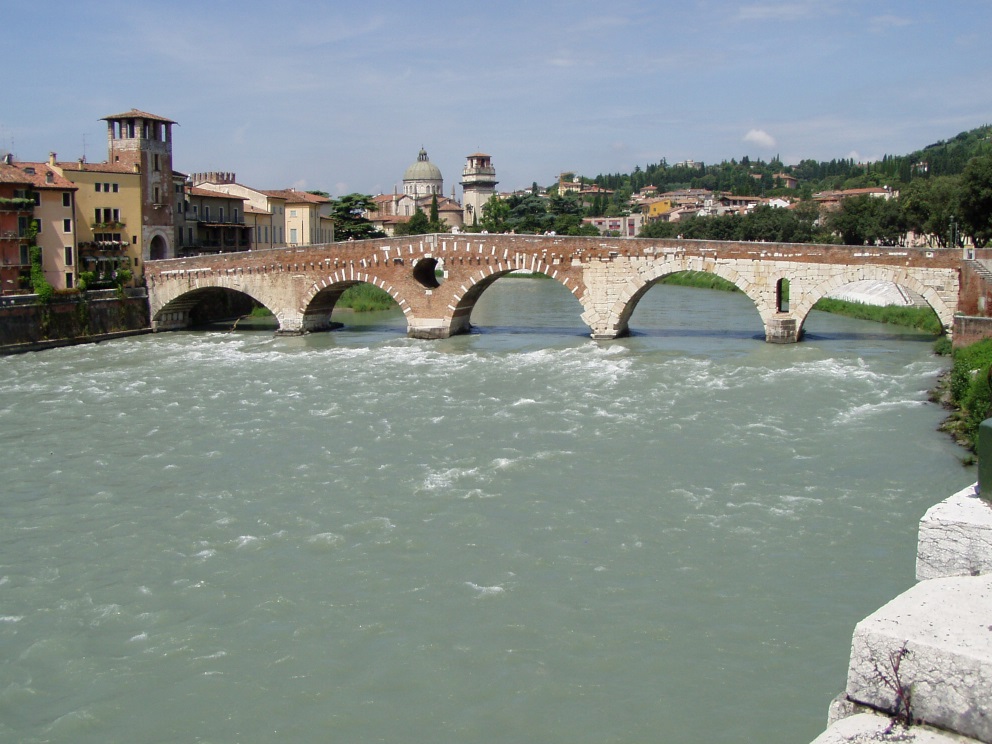
The oldest bridge in Verona; Roman in origin, destroyed during WWII and rebuilt from the original pieces.
Decided to swap the van whilst in Verona for something a little more “mature” 😉
Some of the fabulous art inside the cathedral
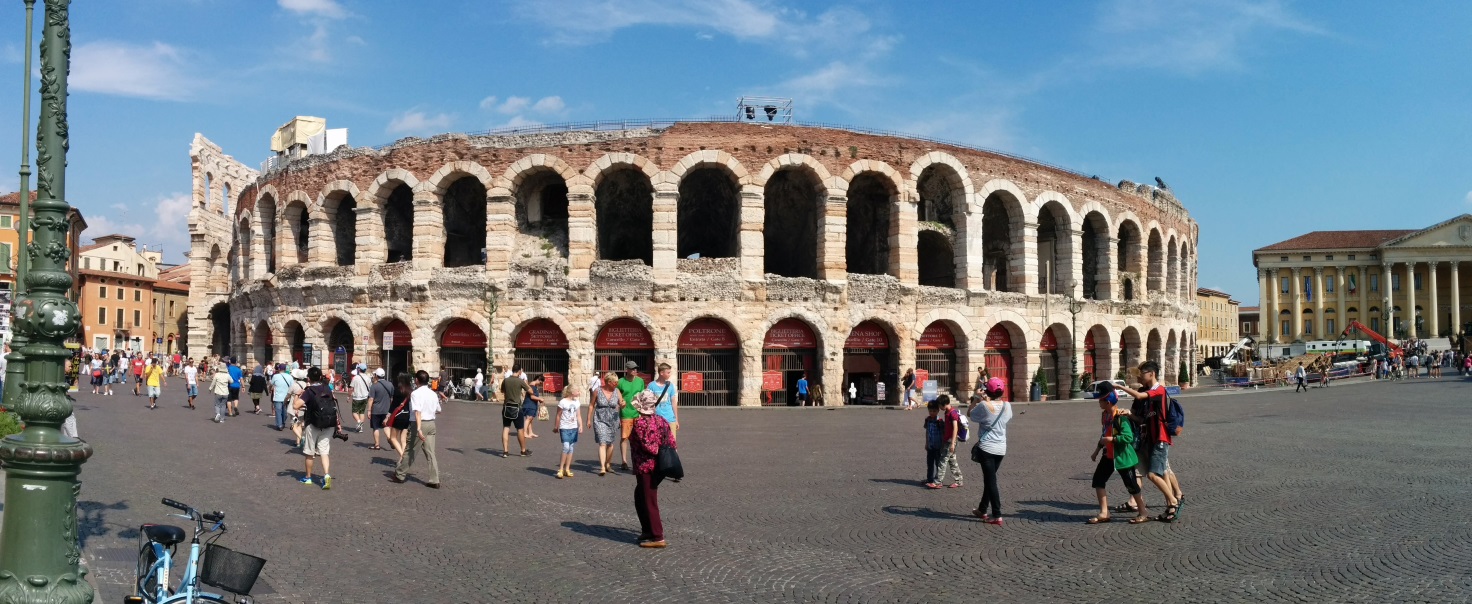
Not another Roman arena?
The inside of the arena – getting ready for tonight’s production of Carmen
Yes it WAS a hard climb up to the top row in the heat!
The by-now-obligatory panoramic shot of the Verona arena

Pompei photos

Looks like Vesuvius is blowing its top, but it’s just cloud!
The Basilica
View over the Forum from the Basilica
A street in Pompei
A Thermopolium – that’s a shop that sells food or drink. Typically a house with its front open onto the street. The large amphorae are embedded into a worktop and food/drink was served from these.
Some of the amazing frescos of life-sized people – currently undergoing some restoration.
The Arena
The inside of the arena

Herculaneum photos

Looking down at the old sea level and beach from the present ground level
Some of the poor people caught in the pyroclastic flow
The beach-front warehouses & boat storage places where many of the townsfolk took shelter from the eruption
A street
Some of the original timbers, showing the burning/charring from the hot ash and dust
Many of the frescos are still in remarkably good condition – and they’re everywhere.
Because Heculaneum didn’t get hit by lava or other major ejecta from the eruption, many of the buildings are remarkably undamaged, providing vast amounts of information about how people lived.
Another amazing fresco

San Valentino alla Muta to Nesselwang

Sun, 27th Jul, 2014:

I actually managed to sleep last night without having to get up and shut all the windows. That’s mainly because it was so cold, we didn’t have any of the windows or skylights open. When I say cold, it must have been all of 12° C – a temperature not encountered for several months. In fact, I don’t think we’ve experienced anything under 20° C for the last month, so this was a bit of a shock to the system.

Today, we didn’t actually intend to travel very far, so a leisurely breakfast followed by a bike ride seemed the thing to do.

San Valentin nestles at 1470 metres above sea level between two lakes: Lakes Rescia (Reschensee) and Muta (Haidersee). Lago di Rescia is quite long – about 8km – with the small town of (guess what) Rescia at the Northen end. Rescia is the last town in Italy before the Austrian border. We decided to do a round trip of Lago di Rescia.

It was still pretty cool when we set off into the teeth of a Northerly wind. Being a lake, the trail around it was pretty flat and so easy going, although there are a few short, sharp climbs & descents on the Western side as we came back.

There were loads of kite-surfers out on the lake, though not a single windsurfer. Seems like windsurfing is pretty much dead these days :-(.

Kitesurfers. I noticed they were all wearing winter wetsuits!

The most interesting thing about Lago di Rescia – apart from it being in a stunning location – is that it has the top of a church tower sticking out of it, by the town of Curon Venosta. An odd place to build a church tower, you might think, but this one was built long before the lake existed, and succumbed to more contemporary requirements for consistent water supplies. It’s now a protected structure, apparently floating on the lake.

I wonder what happened to the clock?

We cycled up to the border crossing; about 2km N from the top of the lake. We can now claim to have cycled from Italy to Austria and back in a day!

Surely not a selfie?
The orange Orange at 1455m (MTB people will understand)

Time to move on…

We hit the road after lunch (i.e. about 15:30!), over the top of the pass where we’d cycled, & on into Austria, pausing only to buy the obligatory “vignette” that allows you to use the Austrian Autobahnen – valid for 10 days, mind.

Over Fernpass – a wonderful, twisty, steep pass that bring back memories from long ago when we lived in Germany, and travelled over Fernpass several times. We got lucky with traffic today: It was all heading South. And there was a heck of a lot of it. An astonishing number of vehicles were Dutch and Belgian – probably 30% of all vehicles – with the remainder being German, Austrian and Italian.

We crossed Austria in surprisingly quick time, leaving us feel ripped-off for the vignette, and on into Germany. We have holed-up in Nesselwang in the Allgäu – the southern-most part of Bavaria – for the night. Again, it’s a place that holds lots of memories for us having stayed here several times when we used to live in Germany. We also came here with both Joy’s parents & my parents on separate occasions, and once with Joy’s sister (in the winter). Nothing much has changed – which pleases me greatly, as there is no need for anything to change. The Gasthof Post Brauerei is still there, as is the Gasthof Bären – where we felt compelled to have a quick beer tonight.

Gasthof Bären, Nesselwang

We also located the Bäckerei, so I can look forward to major pretzel overload for breakfast tomorrow. It’ll make a change from all the horrible bread we had to endure in Italy!

San Valentino alla Muta

Sat, 26th July, 2014:

Last night, there was a huge storm. It started at around 04:30 at which point I had to do the rounds of closing all the windows & skylights, and place the drip-collection bucket. By 10:30, it was just beginning to ease off bucketing it down, though the lightning & thunder carried-on a while longer. We left Lazise with the intention of driving back up to Heiterwang, in Austria.

With one thing and another, it got quite late when we actually left, and I needed to empty the contents of my bank account into the fuel tank. We’d seen a relatively inexpensive petrol station on the road from Peschiera del Garda – about 10 mins drive away – and decided it would be worth the drive to save on the fuel (which is very expensive in Italy). We pretty soon realized that the traffic was really heavy around the lake. Then came the dawning realisation: It’s Saturday: change-over day for most holiday-makers.

Fuel bought, then back the way we’d come, hit the main road and came to an immediate stop. 20 million holiday-makers all trying to head back to the Autostrada leading back up to the Brenner Pass. Sense of humour failure rapidly followed. After we got moving, we decided to take the back roads – seldom a good option in Italy as anything that’s not a motorway doesn’t have any tolls and is therefore not fit to be driven-on: I’m sure I’ll need new shock absorbers when we get back.

Long story short; we took the main road all the way up to Bolzano, running in parallel with the Autostrada. Sometimes we were stopped; sometimes the Autostrada was stopped. We then decided not to go over the Brenner Pass, but instead to head West from Bolzano, through Merano, and along the “Weinstrasse” (this part of Italy is mainly German-speaking) and over the Rescia Pass. We’re presently at 1450 metres above sea level in San Valentino alla Muta. A spot high up in the mountains between two lakes, that’s as cold as it is beautiful. And it’s raining.

Verona

Fri, 25th July, 2014:

We left our overnight spot early yesterday as we knew we had a long, long drive ahead of us up to Verona: Some 630km if Google maps is to be believed. We also had the additional challenge of not knowing exactly where we’d be staying when we got there.

We couldn’t find any campsites in Verona, so our plan was to stay at Lazise – the same Sosta close to Lake Garda that we stayed at 3 weeks previously when heading South – and then travel in to Verona from there. The only feasible way to do this would be by train from Peschiera del Garda; some 15 minutes drive away,  but a lot of ifs and buts needed to be addressed for this to work…

  • There must be reasonably regular trains between Peschiera and Verona
  • There must be a car park available at the railway station in Peschiera
  • The car park must be able to fit our motorhome
  • We would need to be in the car park early enough to be able to park, assuming it would fill-up with commuters
  • There must be camping places available in Lazise (it IS main holiday season now, and Lake Garda is an EXTREMELY popular destination)

So we altered our route to get to Lazise via Peschiera to check out the situation.

It turned out to be a 10 hour drive up to Peschiera, with a couple of short stops. We found the station; it had a car park that charged just €6 to park all day; there were trains every hour. So far, so good,

Drove to our parking area / Sosta in Lazise – just 5 motorhomes parked there (there are places for about 150, although only 2 toilets & 2 showers!). Everything falling into place. This happens very rarely for me.

We managed to get up, breakfasted and off-site by 08:00, giving us plenty of time to get to Peschiera in the rush-hour traffic. There was none. The station car park was empty. Most excellent.

Train tickets cost just €3.30 each and the ticket machine was working. Bargain. We were on the 09:01 train & in Verona by 09:20.

First stop was the Porto Nuovo (the “new” gate, built some time in the 17th century). Then a walk up to the Roman amphitheatre (or arena). This is the 3rd largest surviving Roman amphitheatre (after Rome and Capua), and is just 3 metres larger on each axis than the one at Pompei.

In the summer, the arena is given over to concerts every evening. Tonight’s performance was to be Carmen. Tickets were available (as long as you have deep enough pockets), but the performance only started at 10pm and was due to finish at 1am. There were no trains back at this time which made the opera a non-starter for us. Pity

Instead, we walked up to the cathedral and spent a good 1 1/2 hours in there; walked over to the oldest bridge in Verona (Roman, but destroyed in WWII and rebuilt using the original materials), saw the ruins of the Roman theatre (under renovation, of course), and Juilet’s balcony; most of the ancient piazzas and generally walked the soles off our shoes. We then paid to  visit the arena: I’m sorry to say it was probably the worst €6 each for for  long time. There’s actually nothing to see; no guide book or any other form of information available; nothing about the history or construction. Disappointing.

Other than the arena, a very interesting day – also not too hot (though certainly hot enough in the sun). We even got a train back – having first stopped at a cafe for a “craft beer” (Hirter – an Austrian brewery. Marginally better than average Italian beer). We caught a suitable return train and our van was still there in the car park, and hadn’t been broken into. Excellent!

Again, no pictures due to lousy internet connection, but watch this space…