





Sun, 27th Jul, 2014:
I actually managed to sleep last night without having to get up and shut all the windows. That’s mainly because it was so cold, we didn’t have any of the windows or skylights open. When I say cold, it must have been all of 12° C – a temperature not encountered for several months. In fact, I don’t think we’ve experienced anything under 20° C for the last month, so this was a bit of a shock to the system.
Today, we didn’t actually intend to travel very far, so a leisurely breakfast followed by a bike ride seemed the thing to do.
San Valentin nestles at 1470 metres above sea level between two lakes: Lakes Rescia (Reschensee) and Muta (Haidersee). Lago di Rescia is quite long – about 8km – with the small town of (guess what) Rescia at the Northen end. Rescia is the last town in Italy before the Austrian border. We decided to do a round trip of Lago di Rescia.
It was still pretty cool when we set off into the teeth of a Northerly wind. Being a lake, the trail around it was pretty flat and so easy going, although there are a few short, sharp climbs & descents on the Western side as we came back.
There were loads of kite-surfers out on the lake, though not a single windsurfer. Seems like windsurfing is pretty much dead these days :-(.

The most interesting thing about Lago di Rescia – apart from it being in a stunning location – is that it has the top of a church tower sticking out of it, by the town of Curon Venosta. An odd place to build a church tower, you might think, but this one was built long before the lake existed, and succumbed to more contemporary requirements for consistent water supplies. It’s now a protected structure, apparently floating on the lake.

We cycled up to the border crossing; about 2km N from the top of the lake. We can now claim to have cycled from Italy to Austria and back in a day!


Time to move on…
We hit the road after lunch (i.e. about 15:30!), over the top of the pass where we’d cycled, & on into Austria, pausing only to buy the obligatory “vignette” that allows you to use the Austrian Autobahnen – valid for 10 days, mind.
Over Fernpass – a wonderful, twisty, steep pass that bring back memories from long ago when we lived in Germany, and travelled over Fernpass several times. We got lucky with traffic today: It was all heading South. And there was a heck of a lot of it. An astonishing number of vehicles were Dutch and Belgian – probably 30% of all vehicles – with the remainder being German, Austrian and Italian.
We crossed Austria in surprisingly quick time, leaving us feel ripped-off for the vignette, and on into Germany. We have holed-up in Nesselwang in the Allgäu – the southern-most part of Bavaria – for the night. Again, it’s a place that holds lots of memories for us having stayed here several times when we used to live in Germany. We also came here with both Joy’s parents & my parents on separate occasions, and once with Joy’s sister (in the winter). Nothing much has changed – which pleases me greatly, as there is no need for anything to change. The Gasthof Post Brauerei is still there, as is the Gasthof Bären – where we felt compelled to have a quick beer tonight.

We also located the Bäckerei, so I can look forward to major pretzel overload for breakfast tomorrow. It’ll make a change from all the horrible bread we had to endure in Italy!
Sat, 26th July, 2014:
Last night, there was a huge storm. It started at around 04:30 at which point I had to do the rounds of closing all the windows & skylights, and place the drip-collection bucket. By 10:30, it was just beginning to ease off bucketing it down, though the lightning & thunder carried-on a while longer. We left Lazise with the intention of driving back up to Heiterwang, in Austria.
With one thing and another, it got quite late when we actually left, and I needed to empty the contents of my bank account into the fuel tank. We’d seen a relatively inexpensive petrol station on the road from Peschiera del Garda – about 10 mins drive away – and decided it would be worth the drive to save on the fuel (which is very expensive in Italy). We pretty soon realized that the traffic was really heavy around the lake. Then came the dawning realisation: It’s Saturday: change-over day for most holiday-makers.
Fuel bought, then back the way we’d come, hit the main road and came to an immediate stop. 20 million holiday-makers all trying to head back to the Autostrada leading back up to the Brenner Pass. Sense of humour failure rapidly followed. After we got moving, we decided to take the back roads – seldom a good option in Italy as anything that’s not a motorway doesn’t have any tolls and is therefore not fit to be driven-on: I’m sure I’ll need new shock absorbers when we get back.
Long story short; we took the main road all the way up to Bolzano, running in parallel with the Autostrada. Sometimes we were stopped; sometimes the Autostrada was stopped. We then decided not to go over the Brenner Pass, but instead to head West from Bolzano, through Merano, and along the “Weinstrasse” (this part of Italy is mainly German-speaking) and over the Rescia Pass. We’re presently at 1450 metres above sea level in San Valentino alla Muta. A spot high up in the mountains between two lakes, that’s as cold as it is beautiful. And it’s raining.
Fri, 25th July, 2014:
We left our overnight spot early yesterday as we knew we had a long, long drive ahead of us up to Verona: Some 630km if Google maps is to be believed. We also had the additional challenge of not knowing exactly where we’d be staying when we got there.
We couldn’t find any campsites in Verona, so our plan was to stay at Lazise – the same Sosta close to Lake Garda that we stayed at 3 weeks previously when heading South – and then travel in to Verona from there. The only feasible way to do this would be by train from Peschiera del Garda; some 15 minutes drive away, but a lot of ifs and buts needed to be addressed for this to work…
So we altered our route to get to Lazise via Peschiera to check out the situation.
It turned out to be a 10 hour drive up to Peschiera, with a couple of short stops. We found the station; it had a car park that charged just €6 to park all day; there were trains every hour. So far, so good,
Drove to our parking area / Sosta in Lazise – just 5 motorhomes parked there (there are places for about 150, although only 2 toilets & 2 showers!). Everything falling into place. This happens very rarely for me.
We managed to get up, breakfasted and off-site by 08:00, giving us plenty of time to get to Peschiera in the rush-hour traffic. There was none. The station car park was empty. Most excellent.
Train tickets cost just €3.30 each and the ticket machine was working. Bargain. We were on the 09:01 train & in Verona by 09:20.
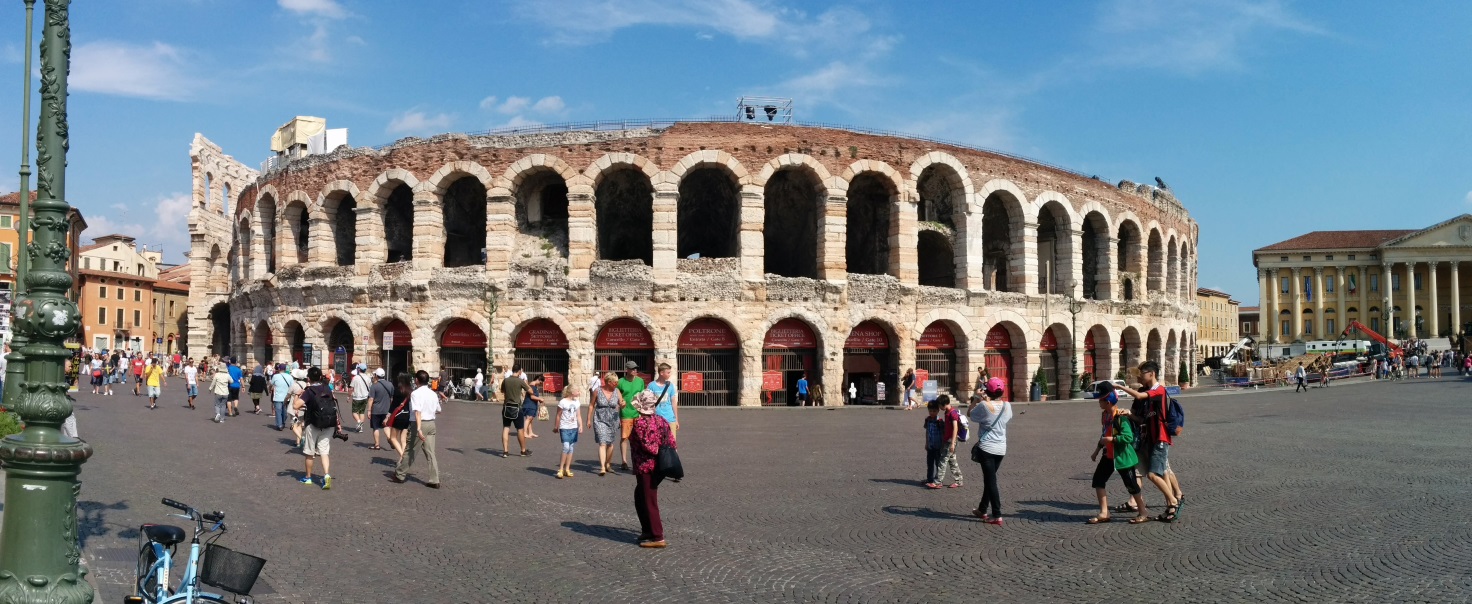
First stop was the Porto Nuovo (the “new” gate, built some time in the 17th century). Then a walk up to the Roman amphitheatre (or arena). This is the 3rd largest surviving Roman amphitheatre (after Rome and Capua), and is just 3 metres larger on each axis than the one at Pompei.
In the summer, the arena is given over to concerts every evening. Tonight’s performance was to be Carmen. Tickets were available (as long as you have deep enough pockets), but the performance only started at 10pm and was due to finish at 1am. There were no trains back at this time which made the opera a non-starter for us. Pity
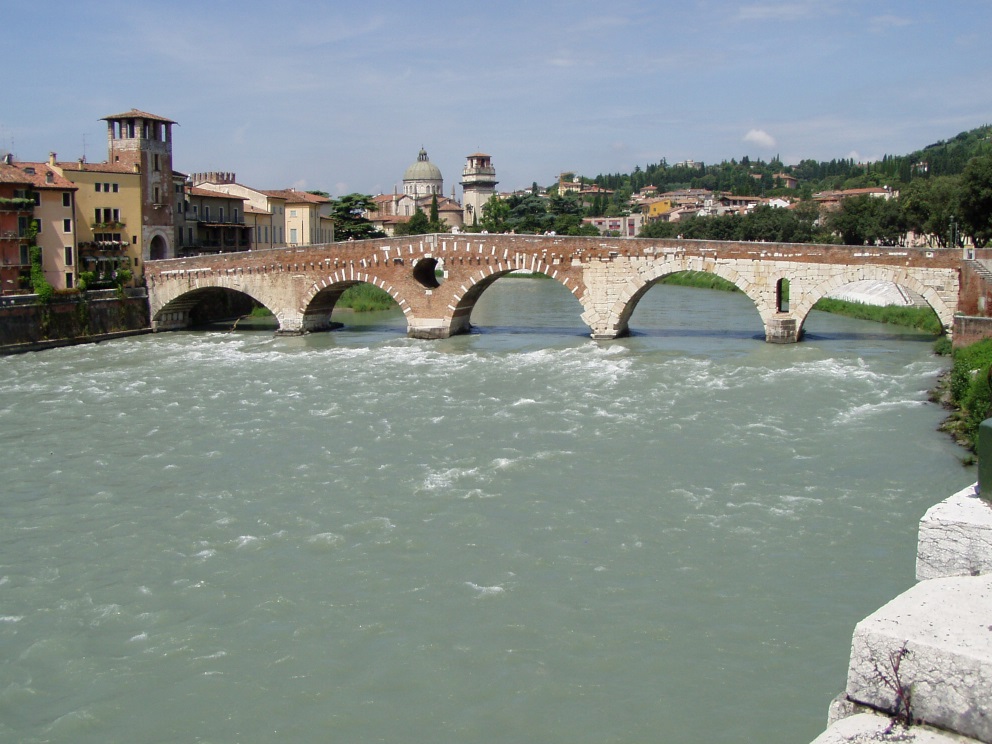
Instead, we walked up to the cathedral and spent a good 1 1/2 hours in there; walked over to the oldest bridge in Verona (Roman, but destroyed in WWII and rebuilt using the original materials), saw the ruins of the Roman theatre (under renovation, of course), and Juilet’s balcony; most of the ancient piazzas and generally walked the soles off our shoes. We then paid to visit the arena: I’m sorry to say it was probably the worst €6 each for for long time. There’s actually nothing to see; no guide book or any other form of information available; nothing about the history or construction. Disappointing.
Other than the arena, a very interesting day – also not too hot (though certainly hot enough in the sun). We even got a train back – having first stopped at a cafe for a “craft beer” (Hirter – an Austrian brewery. Marginally better than average Italian beer). We caught a suitable return train and our van was still there in the car park, and hadn’t been broken into. Excellent!
Again, no pictures due to lousy internet connection, but watch this space…
Thur 24th Jul, 2014
I noticed it before we left Pompei. In fact, I’d have had to be blind not to notice it. We have an attack of ants. Not the huge ones that seemed to prowl around Gargano: these were small. What they lacked in stature, they made up for in numbers. There were millions of them, inside and outside.
We cleared them out as best we could – which wasn’t very, as we were in a rush to get off the campsite before the 4pm deadline, but I couldn’t really figure out where they were coming from. The only theory I had at the time was that they were perhaps scaling the electric hookup cable that lies on the ground, and passes into the van’s garage, though I hadn’t noticed an army of ants on the cable when I disconnected it.
It was while we were driving up to our overnight stop that I think I figured it out: where we were parked in Pompei, there were citrus trees all around. These were great for providing shade from the sun, but not so great for depositing loads of wet, soggy leaves in the fly screens on the skylights. I remembered that the branches of one of the trees was in contact with the roof. That must have been it. It would certainly explain why they were marching up & down the roof, down the back of the van, through the door seals & into the van.
We STILL had ants in the van and on the outside two days later – despite having driven through a number of torrential downpours – though continual removals of the stragglers with a bristle brush did seem to finish them off in the end. I’m happy to report zero quantity of van-based ants tonight.
Addendum: 26/7/14: Just found another ant taking a stroll across the dashboard.
…are quite literally on our doorstep. The main entrance to the ruins is a mere 200m away from where we’re parked in this otherwise not-so-wonderful campsite.
We’d already bought tickets yesterday for both Herculaneum & Pompei. This was fortunate, as – by the time we got to the entrance, several coaches of assorted Americans, Japanese, et al and a train load of other visitors all arrived at once, eager to join the queue at the ticket counter. We breezed through & bought our audio-guides in double-quick time.
The ruins of Pompei are vastly more extensive than what has been excavated at Herculaneum. The first excavations of Pompei were started in the 1750s, although the lack of knowledge of preservation methods resulted in many artefacts being irretrievably lost. Only a small portion of Herculaneum has been excavated due to it having been built over, and the slight inconvenience of people living in the buildings over the site, so it’s not really well understood how big Herculaneum was.
On the other hand, it’s known that about 70% (IIRC) of Pompei has now been excavated. Nothing else was ever built over the site, so access is easier.
Pompei is still being excavated, explored (slowly) and renovated even today. Unfortunately, this has resulted in many of the buildings being “out-of-bounds” to the visitor. However, the sheer scale of the place still gives plenty of opportunity to see how it was governed and administered; how the wealthy & the less wealthy lived; the houses that doubled as shops; the villas and so on.
We managed to spend 5 hours there, and were getting pretty hot & footsore after that time, although we probably only saw about 50% of the ruins. If you ever get the opportunity to visit; do it.
We needed to get the van out of the campsite before 4pm to avoid another day’s charge. We managed just in time, and then started the long drive North, heading up towards Rome before finding our overnight stop – once again in San Giovanni Incarico, having been unable to locate the preferred Sosta that was allegedly at Cassino.
Again, poor internet bandwidth prevents me from uploading photos, right now, but I’ll do this later when I get chance.
Tue, 22nd July, 2014:
We know we’re in Pompei – a town that got destroyed by the eruption of Vesuvius in 79AD. We also know that Vesuvius is an active volcano, and that its activity has been increasing over the last several years and that vulcanologists are suggesting that its next eruption is due, or even overdue. Yet still people flock to Naples to live and to work. It’s not a great city: pretty overcrowded and lots of poverty. No-one seems terribly worried that they’re living on the slopes of an active volcano, or that, when Vesuvius next pops its lid, much of Naples will almost certainly cease to exist.
This morning at around 6:00, it was just light. I was awake, and could hear occasional rumbling in the distance. Joy could hear it, too. And we kept hearing it. I don’t suppose I actually, really believed it could be the stirrings of Vesuvius, but at that time of the morning, and when you’re still half asleep, the mind plays strange tricks. The rumblings got louder, and then the rain started. Up we got to shut all the skylights, and to place the drip collecting bucket (aka washing-up bowl) in position. It was nothing more than a good old thunderstorm. And about time, too: not had one of those for almost 1 full week now.
Despite being in Pompei, we’d decided to do Herculaneum first – it’s a short ride on the Circumvesuvio railway that runs from Sorrento into Naples. Ten stops, ½ hour, and just €1.80 each way got us to Ercolano. It’s not a modern train. It also runs on a smaller-than-standard-gauge track which allows it to get round some pretty tight corners.
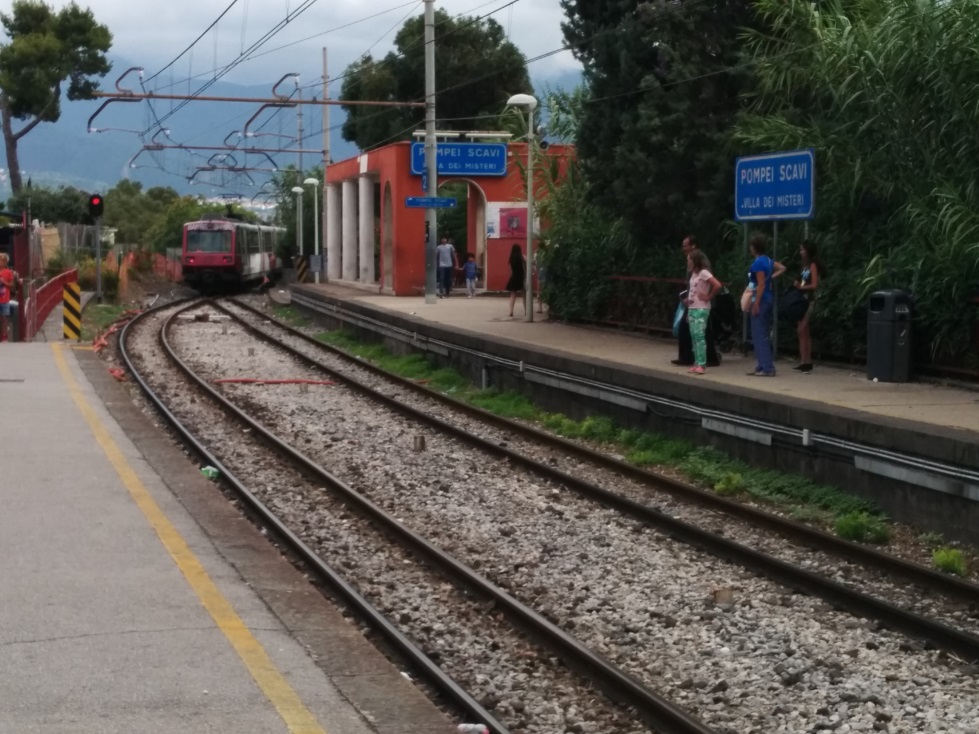
It stopped raining when we got off the train, and the temperature was a very bearable 24 or 25 degrees, albeit somewhat humid. Better than the searing heat one could normally expect in July for trogging round old ruins. The ruins themselves are a revelation: We spent over 4 hours at the site; and that’s despite many of the buildings been closed for either restoration or because of danger to the public.
The whole town disappeared off the face of the planet in 79AD, just 17 years after a major earthquake had caused major damage in 62AD. It was buried under (get this) 23 metres of ash, dust & pumice from the pyroclastic flow. Much of the town was still undergoing renovations from the earthquake when the eruption occurred.
The bottom of the town used to be on the shoreline, and there are a number of vaulted rooms for warehouses and boat storage, right there where the top of the beach used to be. These are where many of the poor townsfolk took shelter from the eruption, and whose skeletons and some personal belongings are still there, having been partially excavated from the ash. There is a 23 m high wall now, on what used to be the beach, where they have excavated down to the original level, so it seems a bit odd talking about a beach when there’s an 80 foot tall wall where the sea should be The sea today, is about another mile further out, the land level having risen so much during the eruption.
The buildings give a fascinating insight as to how these people lived, with many of the bigger (i.e. wealthier) houses having wonderful mosaics and frescos, many of which have been remarkably well-preserved. How the archaeologists manage to determine what the various rooms were and how they were used is amazing. However, there were many, many artefacts that were perfectly preserved, including documents, materials, timbers, personal possessions, (almost all of which have been removed to the archaeological museum of Naples, which we won’t have time to visit), allowing sometimes even the owner of the house at the time of the eruption to be identified by name.
I have loads of photos, and not enough internet bandwidth to post them now. I’ll try to set up a photo gallery when I get a better connection.
Tomorrow, the ruins at Pompei. Will my duff knee take another day of this?…
Mon, 21st July, 2014
We’ve arrived in Pompei! This is very exciting because – although I’d often talked about coming here – I never really believed we’d make it.
It was sad to leave Parco del Gargano: It was such a wonderful, friendly site, I could have happily stayed there much, much longer. But time waits for no man (or woman) and we have to be back at our daughter’s house near Stuttgart by the 28th July; in time for our eldest grand-daughter’s 5th birthday.
Also, we’d been practically eaten alive. The bugs & biting beasties must have been bred specially for us. And astonishingly, the shops don’t seem to major in insect repellents & bite-easing lotions & potions. I stopped counting at over thirty bites on various bits of my anatomy: some where they had absolutely no right to be.
We were woken (still in Gargano) in the wee small hours by what sounded like rain. Bugger! We’d jury-rigged a washing line between the awning uprights/legs, from which were dangling all of our towels, mountain bike shorts and other bits. Also, our bikes were outside, plus table & chairs. The awning is not supposed to be rolled away wet either (obviously its use would be completely impractical back home, then!). It was a hot night, too. The hottest yet, so all our windows & skylights were wide open.
When it rains, being in the van is not unlike being in a tent. I.e. it’s noisy. A few drops of rain, and it sounds like a monsoon. Trouble is, we still think it IS raining like a monsoon. We were both out of bed and running around outside at 06:00 taking the towels in, winding-up the awning, bringing in the table & chairs with just the occasional raindrop putting in an appearance. What is wasn’t doing in wetness though, was being more than made up for in pine needles. I kid you not: It was raining pine needles. Heavily. Ok, it was very windy up in the treetops, and the dead pine needles were being dislodged. Either that, or the squirrels & crickets have managed to collude and invent a new game.
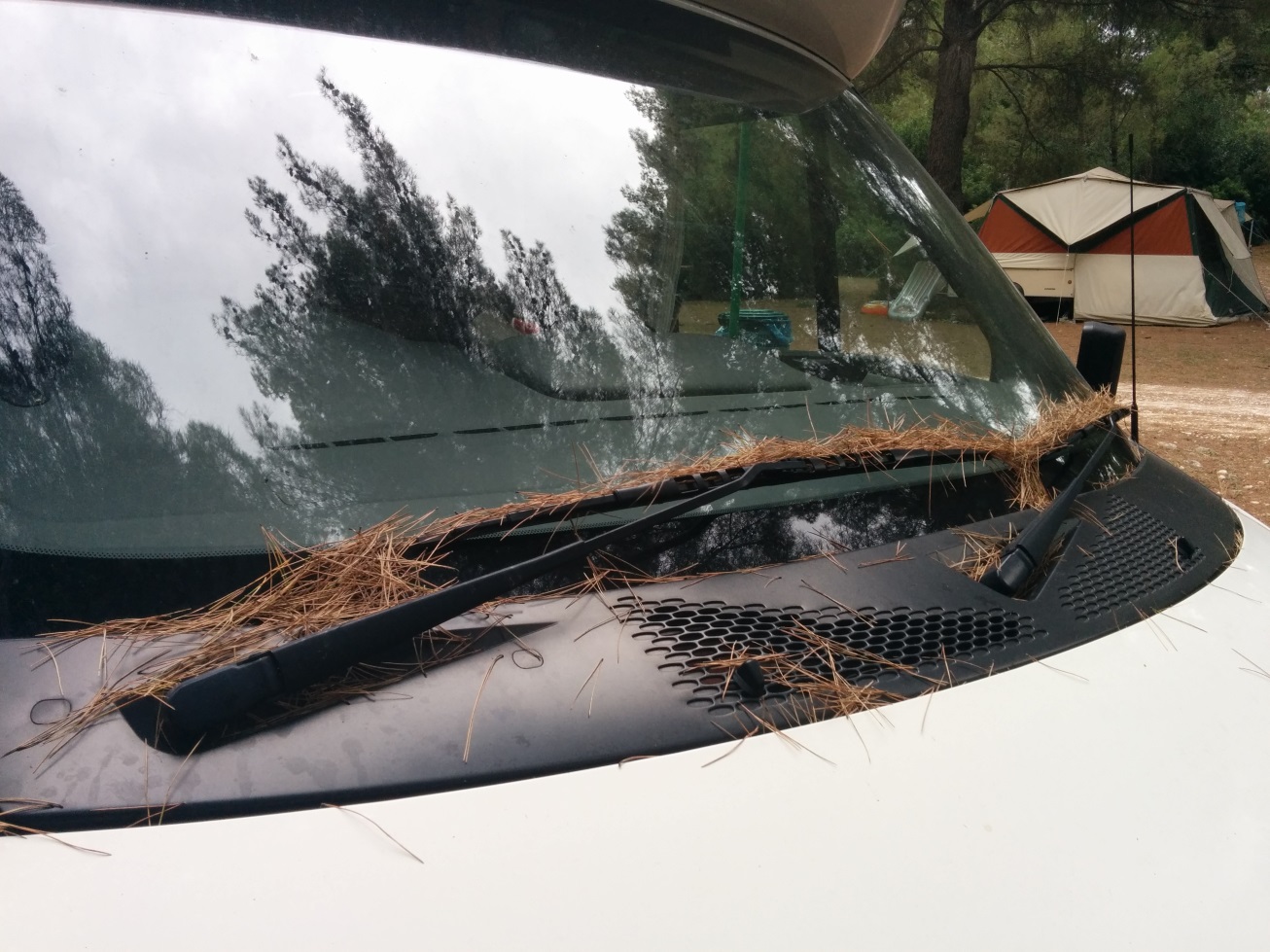
Pine needle rain is not all that much fun. It hurts. Honestly. Especially when being driven by a force 6 wind. Everything was covered in pine needles. This evening, in Pompeii, I’m still brushing bloody pine needles from places where there shouldn’t be any such thing. The awning was full of them. No time to try to dislodge them. They lay like snow on the windscreen wipers. A Dutch family had unwisely chosen this period to move their tent 10 metres to a more favourable location adjacent to our van, just vacated by another Dutch family (most people at the campsite were Dutch; followed by Italians & Belgians. We were the only brits). This was a big tactical mistake. In the 25 minutes it took them to beat the groundsheet into submission in the strong breeze, it had disappeared under pine needles and the rain came down proper. They then abandoned their relocation activities and took up temporary residence of the open-sided, timber yoga hut. For all I know, they may still be there.
The drive from the Gargano promontory was made difficult by the gusty cross-wind. The van is a bit rolly at the best of times. There were a few scary moments of veering right across the lane, but we made it in one piece.
Look at the map of Italy, and it only looks like a stone’s throw from Gargano to Naples. Believe me; it isn’t. Italy is surprisingly BIG. And our van is surprisingly SLOW. It was just over 320km to Pompei, and the exciting bit driving-wise, was getting to Pompei itself. We’ve seen some “interesting” examples of Italian driving, mostly involving blind bends and overtaking, but Pompei drivers took it to a different level altogether. I may have mentioned that the van is somewhat ponderous: You can sometimes write an essay between hitting the accelerator and it heaving itself into motion. Italian drivers seem not to have a great deal of patience. Whilst I was trying to turn left out of a tiny road onto a busy street (only our SatNav could have brought us this way), I must have taken more than 5 seconds to pull out – which would have been impossible anyway. There was a thunderous roar of horns being sounded behind. For me? The car behind decided to pull out and overtake me – completely filling the wrong side of the road – just as another car was turning into our road. That was fun. He made it without any accident, and everyone seemed to accept that it’s perfectly ok to pull out in front of other cars.
The campsite here took some finding. It involved impossibly narrow streets; a yet-again errant SatNav; going the wrong way up a one-way street (if they can do it, so can I!); finding ourselves at the wrong entrance to the Pompei ruins at the end of a cul-de-sac exactly where the campsite wasn’t; getting some directions from the entrance gatekeeper who spoke remarkably good English; retracing our route back down the one-way street (the right way, this time); and eventually arriving at the chosen campsite by the main entrance to the ruins.
The campsite is everything a campsite shouldn’t be. It’s noisy; from the adjacent “round-Vesuvius” (Circumvesuvio) railway line; the enormous group of Californian students 15 metres away watching an Indiana Jones movie – outdoors, if you please; and thoughtless people dumping glass bottles into the recycling bin close by. But we’re not here for the campsite. Tomorrow, we’re on to the train to Herculaneum (“Ercolano”, as the Italians renamed it relatively recently) and the museum.
BTW, the weather is perfect: it’s rained really heavily in Pompei this evening so it’s wonderfully cool right now, and the forecast for tomorrow is for just 24 degrees with a chance of a storm. I was worried we’d get toasted in the blistering heat. I have bought (yet another) umbrella!