


Tue, 22nd July, 2014:
We know we’re in Pompei – a town that got destroyed by the eruption of Vesuvius in 79AD. We also know that Vesuvius is an active volcano, and that its activity has been increasing over the last several years and that vulcanologists are suggesting that its next eruption is due, or even overdue. Yet still people flock to Naples to live and to work. It’s not a great city: pretty overcrowded and lots of poverty. No-one seems terribly worried that they’re living on the slopes of an active volcano, or that, when Vesuvius next pops its lid, much of Naples will almost certainly cease to exist.
This morning at around 6:00, it was just light. I was awake, and could hear occasional rumbling in the distance. Joy could hear it, too. And we kept hearing it. I don’t suppose I actually, really believed it could be the stirrings of Vesuvius, but at that time of the morning, and when you’re still half asleep, the mind plays strange tricks. The rumblings got louder, and then the rain started. Up we got to shut all the skylights, and to place the drip collecting bucket (aka washing-up bowl) in position. It was nothing more than a good old thunderstorm. And about time, too: not had one of those for almost 1 full week now.
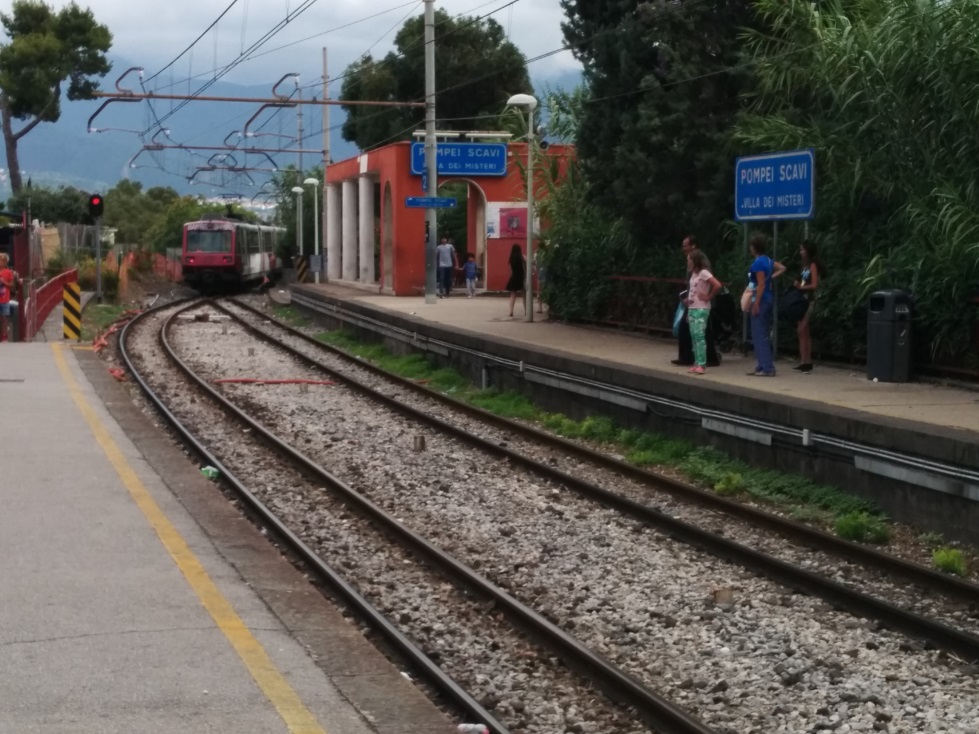
Despite being in Pompei, we’d decided to do Herculaneum first – it’s a short ride on the Circumvesuvio railway that runs from Sorrento into Naples. Ten stops, ½ hour, and just €1.80 each way got us to Ercolano. It’s not a modern train. It also runs on a smaller-than-standard-gauge track which allows it to get round some pretty tight corners.
It stopped raining when we got off the train, and the temperature was a very bearable 24 or 25 degrees, albeit somewhat humid. Better than the searing heat one could normally expect in July for trogging round old ruins. The ruins themselves are a revelation: We spent over 4 hours at the site; and that’s despite many of the buildings been closed for either restoration or because of danger to the public.
The whole town disappeared off the face of the planet in 79AD, just 17 years after a major earthquake had caused major damage in 62AD. It was buried under (get this) 23 metres of ash, dust & pumice from the pyroclastic flow. Much of the town was still undergoing renovations from the earthquake when the eruption occurred.
The bottom of the town used to be on the shoreline, and there are a number of vaulted rooms for warehouses and boat storage, right there where the top of the beach used to be. These are where many of the poor townsfolk took shelter from the eruption, and whose skeletons and some personal belongings are still there, having been partially excavated from the ash. There is a 23 m high wall now, on what used to be the beach, where they have excavated down to the original level, so it seems a bit odd talking about a beach when there’s an 80 foot tall wall where the sea should be The sea today, is about another mile further out, the land level having risen so much during the eruption.
The buildings give a fascinating insight as to how these people lived, with many of the bigger (i.e. wealthier) houses having wonderful mosaics and frescos, many of which have been remarkably well-preserved. How the archaeologists manage to determine what the various rooms were and how they were used is amazing. However, there were many, many artefacts that were perfectly preserved, including documents, materials, timbers, personal possessions, (almost all of which have been removed to the archaeological museum of Naples, which we won’t have time to visit), allowing sometimes even the owner of the house at the time of the eruption to be identified by name.
I have loads of photos, and not enough internet bandwidth to post them now. I’ll try to set up a photo gallery when I get a better connection.
Tomorrow, the ruins at Pompei. Will my duff knee take another day of this?…