Rothsee and Hilpoltstein, Bayern

Mon 11th – Wed 13th Aug.

The weather has turned. Following Sun night’s downpours, it’s gone much cooler.  Not the best time to be touring the Fränkische Seeland but it’s only 1 1/2 hours away from Heiligenstadt and just to the South of Nuremberg. We’ve decided not to “do” Nuremberg and Munich for several reasons, so this gives us 3 days to enjoy the area before heading back to Ehningen for Clara’s 2nd birthday.

We found an excellent Stellplatz in Heubach; near Hilpoltstein. It’s about 150m from the edge of the lake (Rothsee). Hilpoltstein is within easy cycling distance, just over the other side of the Main-Donau Kanal.

The Rathaus, Hilpoltstein

Hilpoltstein – yet another unspoilt and very old town centre with all the shops we would need. The Brauerei Gasthof zum schwarzen Ross (sadly no longer a brewery) houses a small museum that was unfortunately closed whilst we were there. In fact, much of Hilpotstein was closed or about to close for the rest of August.

Brauerei Gasthof zum Shwarzen Ross

The Gasthof clearly used to be a coaching house containing a yard (Hof) with what used to be stables. There’s a public footpath running from the road, through the Hof and down some steps at the back through part of what used to be the old town walls. There are also the remnants of a moat just outside the wall.

We stay for a beer but it’s pretty cool so we decide to head back to the van for tea.

More rain and a cold night followed by a bike ride around the lake in the morning. There are a couple of nature reserves around the lake and they’re full of geese and ducks.

The garden of a private house on Rothsee stopped us in our tracks

A great pity the weather’s so cool: the lake is really warm, there’s a sandy beach, kid’s playground, bar/cafe, sailing club and boat hire. Clearly a very popular holiday destination, but pretty deserted right now – and it’s the middle of August, for goodness sake.

A deserted lakeside: Rothsee at Heubach

When we cycled on the bridge across the Main-Donau Kanal, we noticed a lock a few hundred metres away so decided to go and take a look.

As I may already have mentioned, the barges travelling the canal can be up to 190 m long and 12 m wide. That is big. What I hadn’t realised from the road is that the lock drops the canal by a staggering 25 m (near enough 80 feet). We were lucky enough to catch a big barge negotiating the lock, and the builders of the lock were kind enough to provide a viewing platform. It would have been rude not to watch.

Approaching the top lock gate

We missed the barge entering the lock but saw the top lock gate rise up from the canal behind the ship’s stern. This was clearly not like any lock I’d ever seen before.

We quickly walked down to the far (lower) end of the lock and had to climb several flights of stairs to reach the viewing platform. By the time we got there, the lock was already half empty and we were staring down the dizzying sides at the slowly descending barge.

It looks like a toy in this photo, but this 190m long barge is dwarfed by the scale of the lock

Eventually the lock was low enough and the lower door opened: The entire steel lower section – probably 50 or 60 tonnes-worth of steel – lifts up on chains providing a gap just large enough for the barge to fit under.
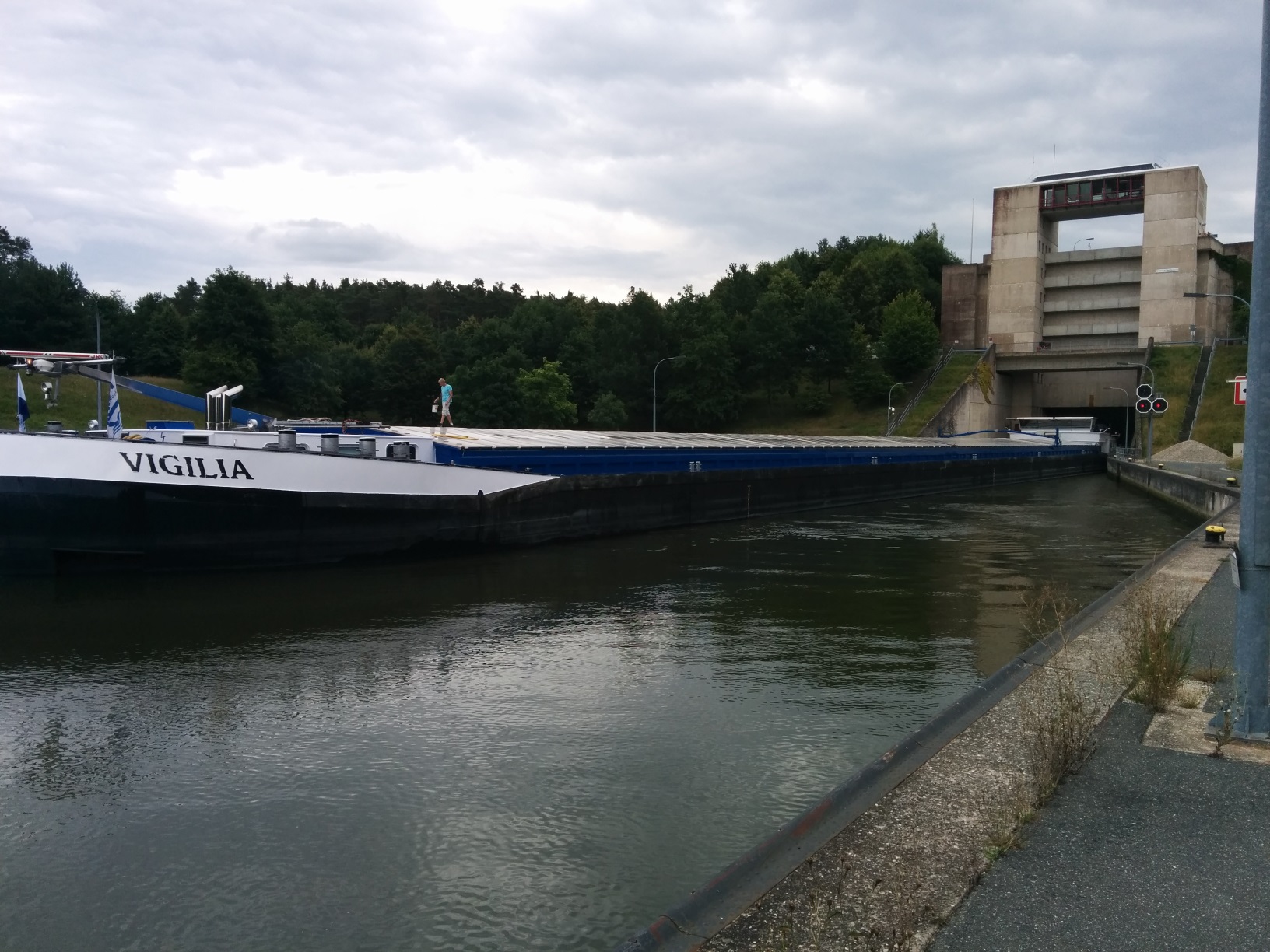
The barge emerges from the lock. The man on the front of the barge provides some idea of the scale.

For the technically-minded, here are some details of the lock:

  • Dimensions: 200m x 12m (useable width) x 24.75m drop
  • Water volume: 60,639 cubic metres
  • Water usage per navigation: 24,698 cubic metres
  • Water level rise/fall rate: 1.5m/minute
  • Built between 1980 and 1985.
  • First used (when the canal opened): 1991
  • Time to negotiate: 25mins

Unlike locks on our canals at home, where water must always be pumped up to the highest level and all the water from the lock is allowed to flow out of the lock (and is therefore “lost”), this locks preserves most of the water from each use by a very clever system of emptying it successively into 3 huge adjacent storage tanks set at varying heights corresponding to the water-level heights in the lock. This way, water can flow under gravity from the lock into the highest tank first, then – as the lock level drops, the top tank is sealed and water can then flow under gravity into the middle storage tank. Similarly for the 3rd (lowest) tank. When the lock is being filled, this whole process then runs in reverse. By this means, most of the water per navigation is preserved, and minimal energy is required for pumping. Clever stuff.

Sleep was disturbed by a family with 2 kids & 2 dogs who’d parked very close by: To be fair, they weren’t particularly noisy but a group of people 5 metres away chatting and laughing into the night when sound travels easily is a bit annoying.

Time to move to Brombachsee…

Heiligenstadt, Bayern

Sat /Sun, 9th/10th Aug.

You may have noticed a particularly beery theme developing over the last several days? Time for a change.

On the town map of Bamberg, there is a Mountain Bike Centre highlighted, about 40 mins drive to the East. Whilst we’ve used our bikes a fair amount, we’ve not actually given them any kind of workout on a proper mountain bike type of trail. So after a short drive, we’ve set up temporary home at the Stellplatz in Heiligenstadt – and very pleasant it is too. It’s actually a car park, just inside the town boundary and just off the main road. By the Parkplatz, traffic has already slowed down to the regulatory 50kph within towns. Not that there is much traffic. A few tractors bringing in the grain from the fields and very little else. We’re alongside the Leinleiter – a small  stream at this point, though it does get bigger further downstream. The most noise we can hear is from the stream.

It;s a very small town. There’s a small supermarket, hair-dresser, Bäckerei, Doner Kebab shop and 3 Gaststätte. There are two other camper vans in the car park, also loaded with bikes. The Stellplatz is free, although there are no facilities. Definitely great for a couple of nights.

BONG, went the catholic church bells every quarter-hour. But they had the good grace to stop overnight. Mass at 08:30 on Sunday was preceded by “untuneful cacophony  on four bells”. It was also followed by the ringing of the single bell of the Evangelical church for a quarter of an hour or so. No way was any one of the 100 or so inhabitants going to unknowingly miss the appropriate service.

There was a helpful mountain bike route sign by the car park, showing 3 different waymarked trails of 32km, 44km and 56km lengths. To be honest, I didn’t have any great expectations of any of these being really fun rides (i.e. lots of twisty singletrack, technical bits, interesting descents – the sort of features you get at any Welsh mountain bike centre) as my experience is that trails in Germany tend to be on the longish, steepish climbs, not very interestingish side.

Heiligenstadt MTB trails. We did Route 3 – Matzenstein.

Joy was a bit concerned about the length of the (32km) trail, but the map clearly showed any number of places where we could take a short cut. With a photo of the trail map on my phone we set off.

It was indeed steep. The first couple of kms of climbing were a bit brutal, but most of it was on road or Feldweg (roads between the fields that are often asphalted). It then evened-out a bit but without any exciting bits.

The most interesting bit was a steep descent down what we felt was a truly ancient valley in the forest, with moss-covered bare cliff faces to our side. One could imagine ancient peoples having lived and died here [I’m reading an interesting book at the mo called “The Old Ways”. It’s about ancient paths and byeways, both on land and sea (marked on charts) with a slightly lyrical premise of the path or trail holding a memory of people’s passing that can be felt down the ages].

In the ancient woods

This steep descent marked 3 things:

  1. We’re right by Veilbronn, approximately half way point, and
  2. It’s lunchtime, and
  3. There just happens to be a convenient Gasthof.

Mountain Biking and big meals don’t normally go together well, and this was no exception. We ate too much. We didn’t intend to – ordering one starter and one main between the two of us – it just turned-out that way.

When we resumed the trail, we found that we were hitting the steepest climbs of all on a full stomach. Needless to say we didn’t exactly fly up them.

The rest of the trail was pleasant enough, but pretty uninteresting and we were glad to get back to base.

That night, another thunderstorm with accompanying downpours caught up with us, and I lay awake for some time wondering if the Leinleiter was going to overflow. Needless to say it didn’t!

Bamberg, Day 4

Fri, 8th Aug.

4th day of our 2-day visit, and I’m in no hurry to leave.

Joy wants to visit the Dom (cathedral). I want to visit the Brauerei Museum, so we go our separate ways for the morning.

The museum is at the top of Michelsberg; one of the 6 hills of Bamberg, and “a bit of a climb” on the bike. It’s absolutely crammed full of breweriana, but there’s no real explanation for most of the artefacts. I was hoping there’d be more about the history of brewing in Bamberg, but I was disappointed by its absence.

The Eiskeller in the Brauereimuseum was interesting: this is a cylindrical structure, three stories down – literally in the Keller (cellar). Its walls are about 3m thick, and it’s about 10m tall with a spiral staircase running down the walls (like a lighthouse). The breweries used to need ice in the summer in order to chill the fermenting wort to slow down the fermentation, and then to store the wort/beer for up to 6 months at a low temperature (lagering). In the winter, they’d chop out large chunks of ice from the frozen river Regnitz, and store them in the Eiskeller, gradually filling it for use in the summer.

I don’t know what size this cask is, but it must be well over a Hogshead (54 gallons). To get through one of those in the 3 or 4 days before it would start to go off requires some serious drinking commitment!
Now those are what I call proper Bierkrugs!

There was a showcase full of bottled beers: one shelf for German beer, the row below being for “Beers of Europe”. Note the Boddington’s bottle.

Beers of Europe?

Note also, however, the bottle of Budweiser next to the Boddy’s: This is a bit anoracky of me, but I’m afraid they cocked-up. That’s a disgusting American Budweiser brewed by Anheuser Busch. It’s NOT the proper Budweiser Budvar Brewery (Budějovický Budvar) in the Czech Republic that it should be. That man on the door was so uncommunicative and unhelpful, I didn’t trouble him with this information.

I decided I needed a beer after the museum, and I wanted to visit the Gasthof Kachelofen to try the St Georgen Buttenheimer Kellerbier on their menu. I was far from disappointed. Joy met up with me in time for a refill before we set out for Brauerei Mahr.

Mahr is a little way out of the town centre. We got there at around 5pm, and had to camp out on someone else’s table. It was absolutely crammed, almost entirely with locals. Ok, the inside rooms were closed – no need for them as it was a pretty hot day – but that still left a couple of hundred people sitting outside. We asked how it was in the winter and were told it’s just the same, only the inside rooms were in use. What a wonderful business these breweries enjoy.

Mahrs beers also come highly recommended, and the gemütlichkeit (roll together the English words “atmosphere” and “congeniality” for a reasonable translation) makes this one of the best Gaststätte in Bamberg.

Mahrs Wirtshaus inside
…and outside

All good things must come to an end, so after we’d had our fill of food and drink, it was time to say au revoir to Bamberg as we wanted to move on towards Nuremberg.

Bamberg, day 3

Thur 7th Aug.

This is the 3rd day of our proposed 2 day visit, and it’s going to be a beer-free, bike-touring day (perhaps!).

Bamberg is a wonderful town – UNESCO-Heritage listed. It’s also small enough to be able to get around by foot or by bike.

I lost track of which Mühlbrücke this was (there are several of them!)
Little Venice
The Alte Rathaus

We want to have a leisurely bike ride around the area, taking in an Edeka supermarket along the way (see previous post about Internet Woes!). I *thought* I’d seen an Edeka near the “other” Stellplatz in Bamberg – the one we couldn’t get into because it was full. I was obviously mistaken – not an Edeka in the area.

But we did come across a nature reserve underneath the main road junction. At least a part of the reserve was there though it did extend beyond. Well beyond. A thoughtfully located map provided us with directions for a ride along the left arm of the Regnitz (the River Regnitz splits into Left & Right arms just to the South of Bamberg). So we followed the Regnitz, taking in the bathing area (pass on that) and the cafe (noted for Kaffee und Kuchen for later in the day). We soon found ourselves back in Bamberg despite the fact we thought we were heading in the opposite direction. Never mind – time for our sandwiches by the old lock before heading South once again.

We headed back S along the Regnitz for several miles, eventually reaching a village called “Bug”. Silly English humour I know, but I couldn’t resist taking photos of the Hotel there – The “Buger Hof”!

Hotel Buger Hof

We crossed over from the Regnitz and cycled over to the aptly-named Main-Donau Kanal. This is – as you might well imagine – a canal that joins together the rivers Main & Donau (or Danube, to most Brits) and thus provides a navigable route all the way from the Black Sea into the North Sea. This is not a canal like (say) the Leeds-Liverpool canal. It is a modern (built 1980 – 1992), mighty, wide, deep & long piece of construction engineering, designed to take ships (barges) up to 190m long and 12m wide.

As we cycled up to the raised banks, an enormous hotel ship passed by heading North towards Bamberg. We cycled to the South, going for several miles further before we came to the mutual decision that  – actually, it’s pretty flat and boring. So we turned around and headed back to the cafe we’d noted earlier for Kaffee and Kuchen.

Whilst we were in Bug, I spotted that increasingly rare object – a phone box. Even more unusual was the set of phone books hanging from the rack in there. Ah-ha – might there be an Edeka listed in there? Out of the five books hanging in there (all of which I was slightly reluctant to touch without rubber gloves!), I managed to find one who’s form of listing I could understand. And – yes; there’s an Edeka listed in it. It’s outside of Bamberg and not exactly on the way home, but worth a detour to get a phone top-up.

Bamberg, day 2

Wed 6th:

It’s our wedding anniversary. To celebrate, we decided to cycle into Bamberg, drink a few beers (possibly), and have a meal. Sounds a bit like last night, in fact.

We started off at Brauerei Fässla – simply because it was right alongside the bicycle alley leading onto the Königsstrasse. Again, no problem taking our bikes down the entrance and into the Biergarten/Atrium. I tried the Zwergla – a dark, rich, 6% Märzen.

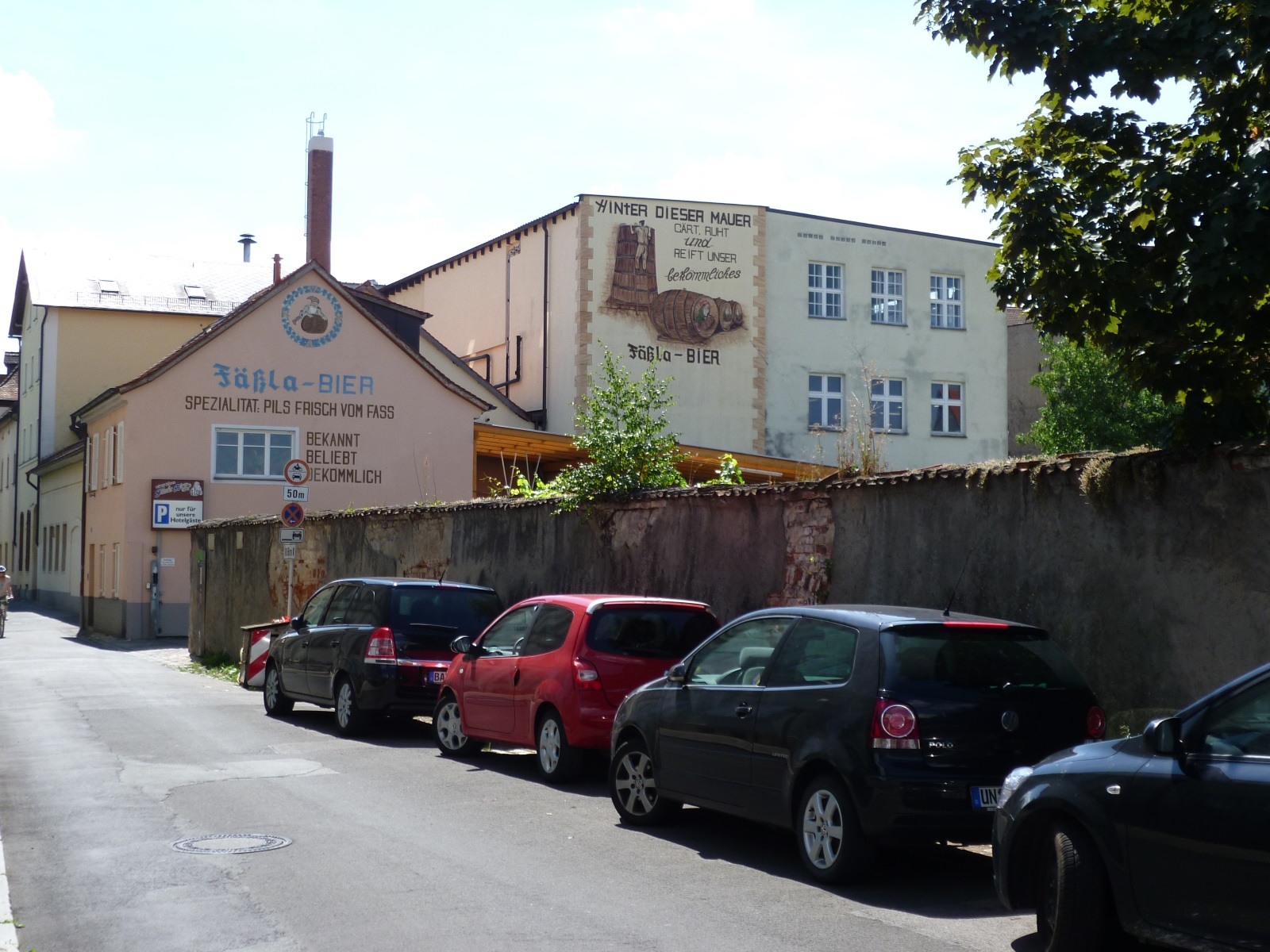
The first sighting of Fäßla from the cycle route
Brauerei Fäßla

One of my main reasons for wanting to come to Bamberg was for the Rauchbier (literally smoked beer). Bamberg is famous for Rauchbier and there are very few other places in the world, never mind Germany, where it is made. In fact, there are now only 2 breweries left in Bamberg that still produce this style.

It may sound weird, or even unpleasant, but Rauchbier often has a “bacon-like” smokiness flavour with sometimes a peppery finish to it that comes from the smoked malt used for brewing.

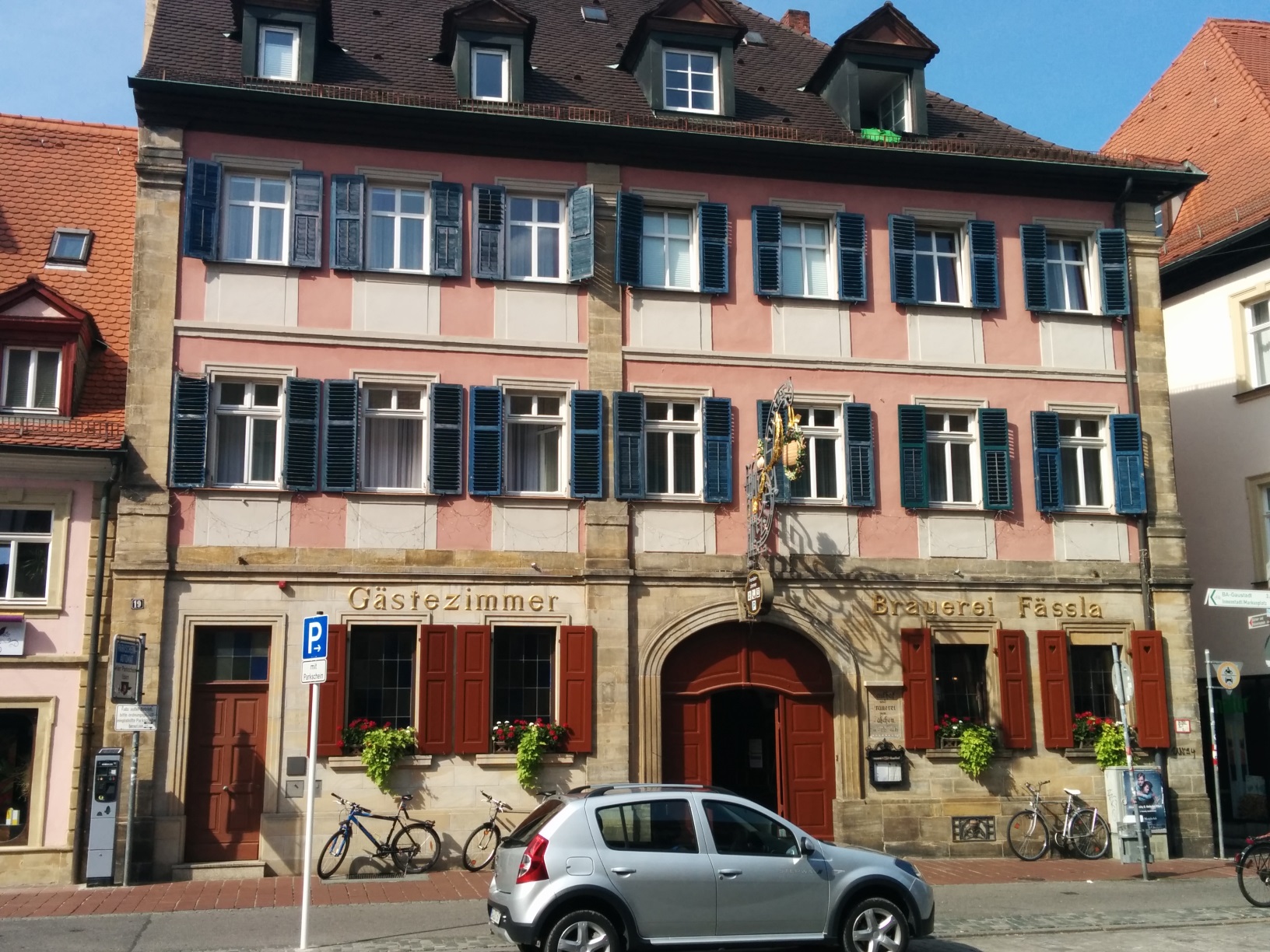
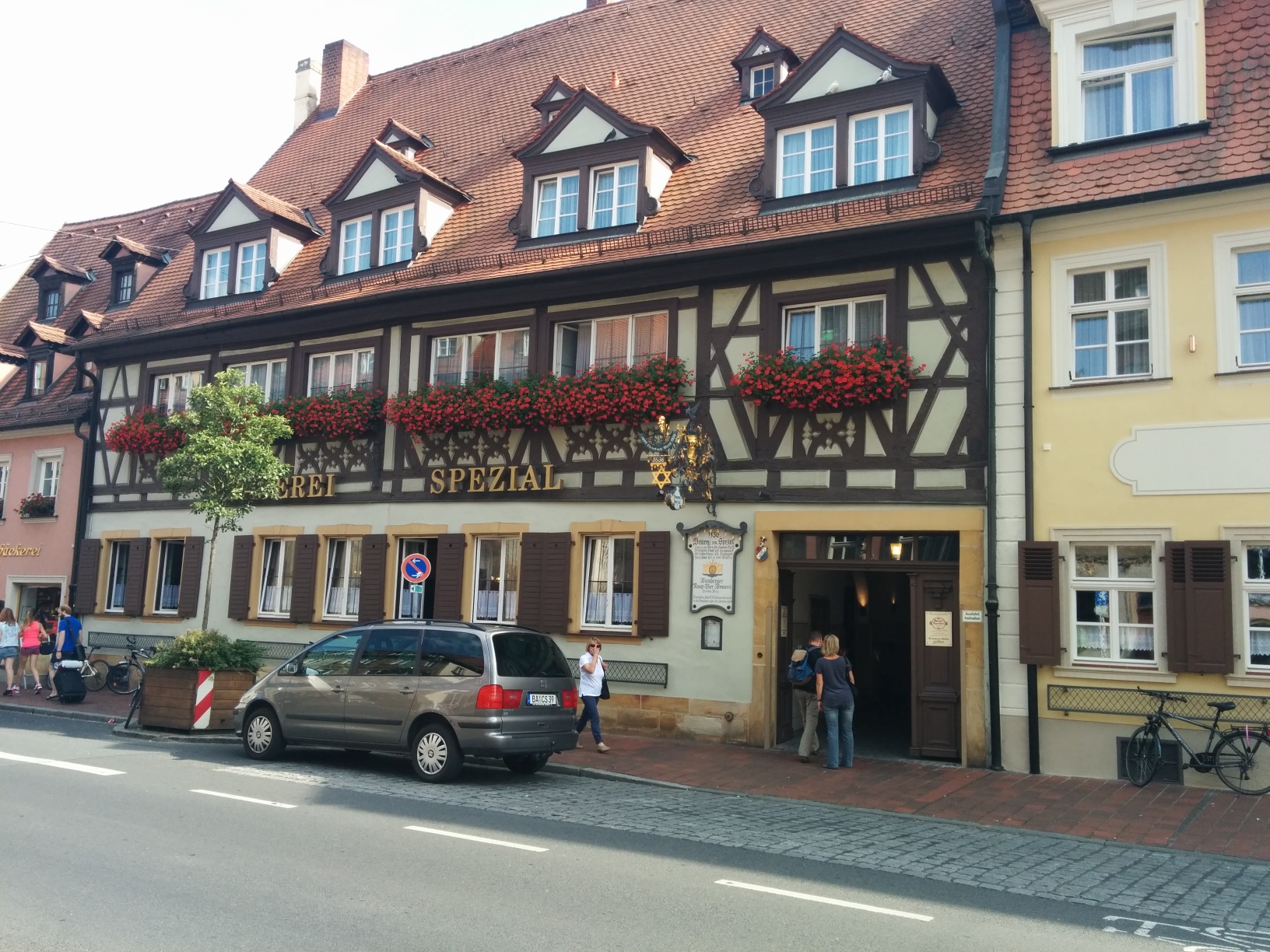
The first Rauchbier Brauerei I had on my list was Brauerei Spezial. It had to be close by Fässla as the street name was the same. In fact, it was on the opposite side of the road. Directly opposite. No more than 15 metres away. Fall out of one into the other if you’re lucky enough to avoid being run down by bicycles and cars.

Brauerei Spezial

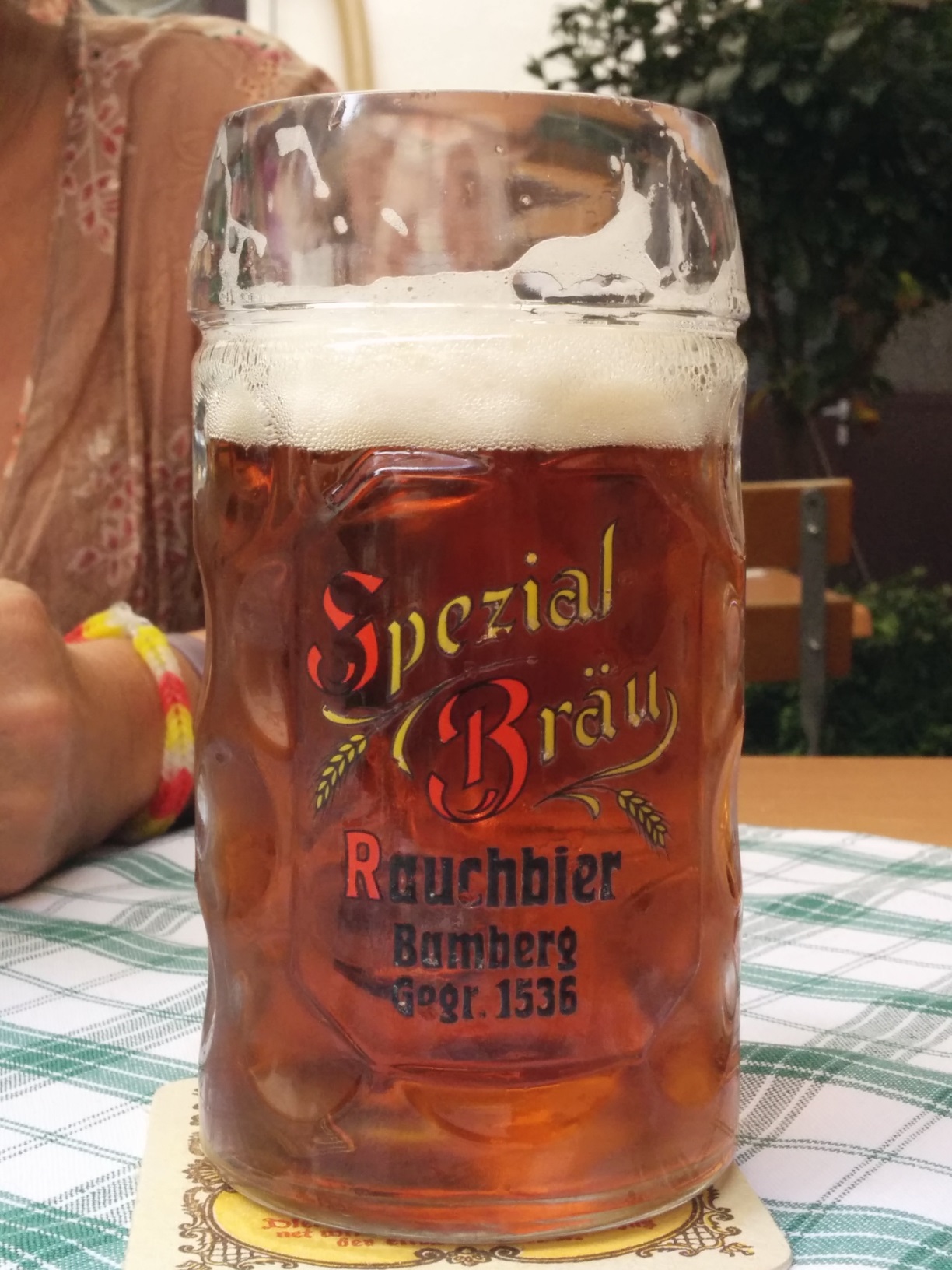
First up for me was the Rauchbier Märzen – a 5.3% smoked dark lager. Well-hopped (again, this is feature of Fränkische beers compared to those from other parts of Germany), with smoky and toffee flavours. Most excellent.

Rauchbier – you can almost taste it from here!

Joy then departed to do some window shopping, and a local joined me at my table. So I had to have another beer just to be sociable. This time, it was an “ungespundetes” (unfiltered) 5% lager. Naturally cloudy, with malt, coriander, and woody flavours. Had a long chat with the local who was telling me all about the maltsters of Bamberg: there are two of them, both with large maltings supplying not just Bamberg, but the whole of Germany. Some of their malt makes it to the UK, apparently.

Time for the next brewery – Schlenkerla. This was a 5 minute bike ride away in the Altstadt, but was most definitely worth it. Again, I was able to park my bike in the Biergarten. This time however, I was unable to find anywhere to sit. It was crammed. I did the German trick of inviting myself to sit on someone else’s table (which is perfectly acceptable in Germany). As soon as they left, their spaces were seized by several Asians. In fact, when I looked around, the place was full of them. A couple more arrived and I was struggling to keep a space free for Joy.

Schlenkerla

Over a Rauchbier Weizen (a most unusual and extremely hard to find beer), I got chatting to the Asian couple who turned out to be Chinese, and from Canton. They were really friendly, and wanted to tell me all about their 11 day tour of Germany (including Füssen, Garmisch-Partenkirchen and Munich in one day). They’d visited England last year but – apart from London and Bath – couldn’t recall where they’d been. Only that they found it very, very expensive (so do I). When their party left, they insisted on taking a photo of me!

In the meantime, I’d started on the Rauchbier Märzen – at 5.1% and probably the best German beer I’ve ever come across. When Joy arrived from her shopping expedition, I had to order another to go with our food. I’m not entirely sure what I ordered, but it seemed to be Bratkartoffeln mit kleine pieces of Schweine. It was exceedingly good.

I’m guessing we left at something around 7:30, and the place was still heaving. As were all the other Gaststätte we passed on the way back to Memmelsdorf.

This is a place I’ll definitely return to in the future.

Bamberg

Tue 5th:

Her at  the top of the windscreen has done it again. About 1km into the (shortish) drive from Würzburg to Bamberg, we hit another Umleitung (diversion) in the middle of town. Off we went on a jolly detour. We were doing all right until she said something like “turn off left then stay left”. I did, but there was another “left” exit immediately following, and the lane I was in peeled-off. Wrong. So she quickly recalculated, and we followed her revised route. In completely the wrong direction again. My theory is that she gets the hump at us not following her every wish & then takes us on a wild goose chase to get even.

Instead of going East towards Bamberg, we were taken some way North and onto a completely different road to that which we’d planned to take.

Anyway – enough of that. We stopped for a bite to eat in a tiny place called Ebrach; just catching the bäckerei before he closed for lunch – he really didn’t seem pleased to see us. It turned out that Ebrach has a 12th century monastery and abbey, with wonderful gardens open to the public. It also has a 16th century orangery – now turned into floral gardens with a central fountain, and a 16th century wine and beer cellar – unfortunately not open. It also boasted the most scrupulously clean public toilets I’ve ever seen, in gleaming stainless steel, complete with electronic sensors to automate anything could atomated and more besides. It also had the most stupidly designed urinal I’ve come across for a long time (albeit fantastically clean). These are housed in what was part of the wine cellar. Obviously the designer believed the ordinary male to be vastly more well-endowed than is really the case, with the result that the floor gets more use than the urinal. This probably explains why the floor had that “just-mopped” look about it, and it was scrupulously clean. I wonder if there are some robots that pop out of some 16th century hatch and mop the floor when there’s no-one looking?

I was pretty fed-up with “windscreen woman”, and hate her dubious pronunciation of German place and street names. So I switched to a German voice to see if the German woman was any better.

We got to our chosen Stellplatz by the park & ride in Bamberg with no further problems. Except that it was full. Pity, because that one was only 15mins walk into the old town. But it WAS by a P+R (Park + Ride), it WAS pretty cramped, and it looked like it might get noisy. A quick glance at the Stellplatzführer revealed another possibility, though it was about 6km outside Bamberg in a small town called Memmelsdorf. We drove round to there: it seemed perfect. A corner of a large car park of the Sportshalle set aside for motorhomes overlooking a brook and with some trees for shade, with the playing fields (unused in the summer) beyond. And there was space a-plenty.

It was 15:30. Time to get the bikes out for a quick trip into Bamberg. First impression: Bamberg is set out for cyclists. Big time. Cars stop at junctions if the bike lane crosses the junction and there are cyclists on it. This took some getting used to as we thought we’d just get mown down. Not a bit of it. The drivers are SO aware of bike lanes crossing road lanes, and bikes certainly seem to have priority just about everywhere. I wonder if we could introduce that as a concept in the UK? The bike lanes where they exist – are also completely clear from any “street furniture” e.g. trees, bus shelters, railings, parked cars, lamp-posts. However, cyclists are also expected to obey the cyclist traffic lights which are fairly common in the town.

We were heading for the Tourist Information office; hopefully before they closed (it takes a good 35 mins into the centre of Bamberg from Memmelsdorf). Fortunately, there are big Info Points (aka “Maps”) all over the city but we still managed to get slightly lost!

The TI office was able to provide small town plans. Thus armed, and with a list of pubs and breweries I was hoping to visit, we alighted at Brauerei Klosterbräu. This was the pub/brewery on my list that’s closest to the TI!

Time to test the Klosterbräu Schwärzla – a black lager. It passed the test. Several times, in fact. Well, it was a very warm day.

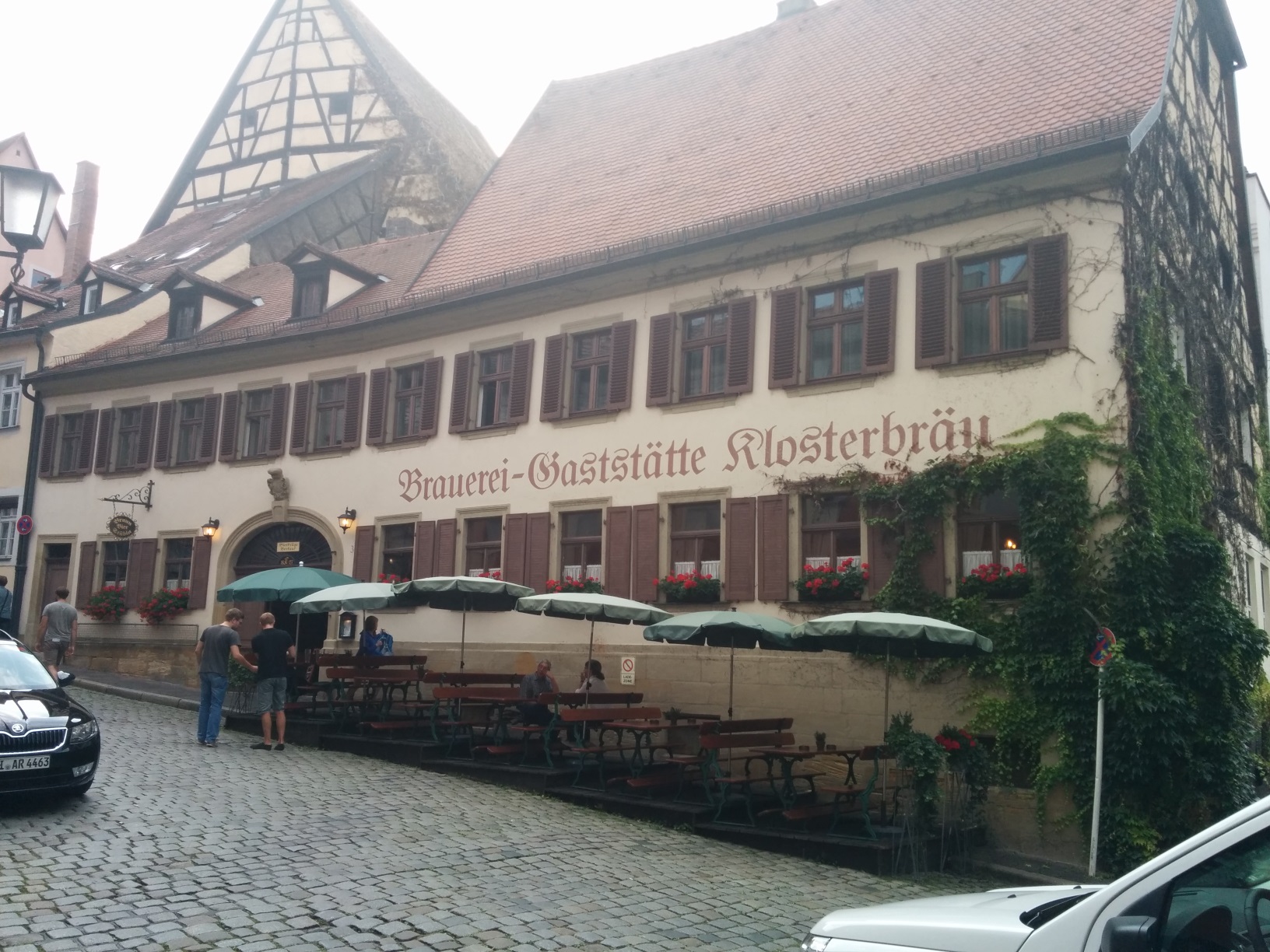
Brauerei Klosterbräu was really an introduction to the fantastic fusion of Gaststätte, breweries, and history seen all over Bamberg. It is a working brewery – the oldest in Bamberg (founded 1533) – producing no less than 9 different beers. It’s also a fascinating building with an ancient passageway leading to an atrium – where we sat and had a meal. Not just Bayerisch food, but Fränkische food. I barely understood a word of what was on the menu, and I consider myself pretty fluent in German.

They were completely unfazed by us taking our bikes into the pub – never batted an eyelid. Must be common here. By 6 pm, there was barely a seat left in the place, neither inside nor outside. Great atmosphere and friendly staff.

Klosterbräu
Cheers!

Colds, diversions and Würzburg

Mon 4th Aug, 2014

It’s time to leave Ehningen and head off towards Bamberg by way of Würzburg. It’s reassuring to know that the girls’ capacity for passing-on colds and viruses is still undiminished. Both Joy & I have sore throats. Kathryn also had a cold whilst we were there and had also lost all senses of taste and smell. This is a worry as we’re planning to visit a number of breweries & Gasthöfe in Bamberg and having no sense of smell or taste will do little to enhance the experience.

Having – or so we though – plenty of time to get to Würzburg, we set our guiding light (the SatNav, or “she”) to avoid motorways and take us via Schwäbishe Hall. We’d also heard on the radio that the stretch of the A8 Autobahn we would have needed to use had become a 10km long parking lot this morning and therefore well-worth avoiding.

The plan got us as far as Leonberg – about 12km. In Leonberg was an Umleitung (diversion) which is always good for throwing our SatNav into a spin. I made the mistake of following the SatNav which then took us along a narrow street, via a couple of right turns, eventually ending up at the point where we’d been diverted from the main road in the first place, only now with no option but to turn back towards from whence we came. Bless her, she’d brought us back onto the chosen route the shortest way possible which – had there been no diversion, would have been just fine. Leonberg is not an easy place in which to turn around, so we decided to (temporarily) abandon our aim of avoiding motorways – having got beyond the traffic jam – and jump onto the A81 for couple of junctions.

We followed the signs for the Autobahnen A8, A81, travelling several miles BACK along the route we’d driven earlier. This was unexpected. We eventually came to the A8 junction which was still suffering traffic chaos. I managed to avoid getting onto the Autobahn by swerving into a road where the sign was pointing to the Leonberg industrial area. So we then did a tour of the industrial area before ending up back in the town, exactly where the Umleitung was.

This time I was going to ignore “her at the top of the windscreen”, and follow the signed diversion route. Hooray! We then followed a bizarre route taking us miles out into the countryside in completely the wrong direction. I decided to listen to “her of the route” again. She continued to take us in the wrong direction.

Several sense of humour failures and threats to throw her in the bin later, we’re about 1 ½ hrs later than expected with a surplus 35 miles or so on the clock. But we were on the right road. Or at least, a road that would eventually bring us back to our road of choice.

We arrived in Würzburg at about 3pm, our SatNav having redeemed herself slightly by taking us to exactly the right spot, first time. This was a large Stellplatz right on the bank of the Main, just 10 minutes walk into the old town. It was also a car park and bus park, so pretty busy. We could watch the barges coming and going towards the lock gates just 500 metres upstream. Some of these barges were huge. Some were even huger as they were – in effect – one barge pushing another in front. To try to put this in perspective, each of these barges was about 2/3 the length of a football pitch. As you might imagine, it takes quite a lot of heavy diesel engine power to push that lot along against the flow of the river.

We took a stroll through the town centre – another fabulous town where everyone hangs out in the many bars and cafes in the balmy warmth. Wonderful atmosphere.

After a brief stop for a bier at a riverside Gasthof, it was back to the van for dinner. The Dutch people in the van next to us had set up their table & chairs right in front of our van. Maybe the view of the river was better than it was 3 metres to the side. Their side. Who knows?

Whilst we were eating, there seemed to be a lot of shouting and swearing from underneath the road bridge – also passing over the Stellplatz – about 50 metres away. Then a loud radio started up, seemingly from the same source. At 9pm, the rock concert at the previously unnoticed stage at the far end of the park started up in competition with the loud under-bridge radio. The radio never stood a chance. Although the music from the rock concert was pretty good, it was certainly no cure for insomnia. Fortunately, the German law forbidding loud noise in public places after 11pm was adhered to and the concert ended bang on cue. The barges didn’t (at some point in the night, the van was resonating to the heavy engines of a passing barge). Neither did shouty-loud-radio-man (who, it turns out, seems to have adopted the bridge as his home). Sleep for me, was not plentiful. A pity, as it was otherwise an excellent location.

In the morning, with “her on the windscreen” programmed to take us to another Stellplatz in Bamberg, we’ll set off for who knows where…

[update – 12th Aug: No photos, I’m afraid. Internet connections have been so poor that I can’t get them uploaded. They will follow in due course…]

More Internet woes

8th Aug, 2014

I’m sitting here in the van stripped down to a pair of shorts (sorry – probably too much information!). It’s 21:30 and 29°C and I’ve just taken a shower after the 7km bike ride back from Bamberg. I’m waiting until midnight’ish before I can go to bed because the electricity supply arrangement on this otherwise good Stellpatz, is €1 for 8hrs worth of supply. All in all, not a bad deal on the face of it. You could power a blast furnace if you wanted to, but only for 8hrs. All I want to do is charge the laptop, smartphones & tablets. The solar panel on the roof will bring the van’s leisure battery back up to full power by mid-morning, so I don’t even need to rely on the mains supply for that.

Our fridge will happily run from any of  – gas (running a little low until I can get to a petrol station that sells LPG); 12V (when the engine’s running); or from mains power. But it’s dumb insofar as it won’t automatically switch to whatever supply is available – it needs a human (or trained monkey – but they’re in short supply) to switch it to whatever is the preferred energy source. It runs most efficiently from mains and – as I might have mentioned – the gas is getting a little low.

So if I were to insert my €1 now and switch the fridge to mains supply (and plug in all our devices that need charging), I’d need to get up at 05:30 when the mains switches off, to either…

  • Get up, go outside and feed the machine again, or
  • Get up, switch the fridge to gas.

Either way, I’d be getting up at 05:30. 05:30 is a perfectly nice time. I have nothing against 05:30. I just don’t want to get up at that time. So I’ll wait until midnight, feed the machine & then get up at a slightly more sensible 08:00 to switch back to gas.

All of this is by way of suggesting that not everything in Germany is perfectly thought out and executed. They may not be the masters of the universe in all respects.

The problem with 8hrs mains supplies however, pales into utter insignificance compared with the utter backwardness of public Internet availability. Maybe we’re spoilt back in the UK, but it seems to be de-rigeur these days for just about every pub, library, cafe, restaurant, swimming pool, coffee house, service station (at cost, of course) et al to offer free WiFi Internet connectivity, albeit often of dubious quality. But at least, it’s available. In Germany – the most technologically advanced country in Europe, where even most urinals automatically flush themselves after your passage – my phone has failed to pick up a single WiFi access point – free or secured. Nada. Nichts.

This has meant that researching one’s next stop is impossible. Even checking the bus or train timetables can’t be done. Not to mention updating this blog. All that is taken for-granted back home. If you don’t have internet connectivity, you’re doomed to the dark ages (and missed buses). So I had to look for ways of getting some kind of mobile Internet access…

My mobile provider back home (T-Mobile) does offer a roaming data tariff whilst abroad. It used to cost £3 per 100MBy per day – which actually isn’t such a bad rate, and I have used it a couple of time. Trouble is, uploading photos to the blog tends to burn up 100Mby fairly quickly – and that’s after I edit all my photos to reduce the size prior to publishing them. Also, last weekend when I decided I needed something better, T-Mobile was saying (on my phone) that there were no further optional “boosters” (as they call them) available to me., until I got a marketing text message from them on Monday offering a new service of £3 per 50MBy/day or £5 per 100Mby/day, or £15 per 500MBy for 7 days. I.e. pretty much a doubling of costs, so they’ve excluded themselves from the competition.

Now researching smartphone Internet deals is pretty difficult with no Internet access. However, during the brief pre-burn-up time of my 100Mby, I managed to find a blog all about mobile phone Internet providers in Germany (in English!). One of the (apparently) best deals is offered by a German supermarket chain – Edeka. €9.95 for 500Mby in 30days. So I bit the bullet whilst in Edeka in Ehningen, and bought myself an Edeka SIM card for €10 that allegedly had €10-worth of credit on it. It uses the Vodaphone network here in Germany which – allegedly – is about the best (sorry about all the “apparently’s” and “allegedly’s”).

I eventually managed to remove the SIM card from my Google handset (the tool for this is at home, of course) and insert the Edeka SIM card. Now I’ve never had a pre-paid tariff before, so am very naive with how these things work. Add to which, all the instructions were (understandably) in German. I thought I’d managed to figure it out. There’s a toll-free number to call that connects with an automated system to register your new SIM card. The system didn’t recognise the SIM card/phone number combination. Fell at the 1st hurdle. However, the system didn’t give up on me, it connected me with a very helpful (real) person who took the details and assured me that everything was hunky-dory. She also confirmed that the €10 free credit could be used for the data tariff (as opposed to phone calls & SMS messages.

The SIM card wasn’t working: Internet access simply wasn’t available. Back to the free phone number. Ah-ha! There was an option to change my tariff to “500Mby in 30 days for €10”. Done. Within seconds, I received a text message saying that my data tariff would be available as soon as I received confirmation of having registered my “account”. What account would that be? It’s a blasted pre-pay phone. And I was told the initial credit could be used for the 500Mby in 30days bit.

I then noticed that I had an Internet connection. Hooray! But my rejoicing was premature: the internet connection was burning up my “free” €10 at a rate of €0.24/Mby. I.e. the phone, rather than the data tariff. It was gone within 5 minutes.

So now, a long way away from the Edeka I know in Ehningen, I need to locate another branch of Edeka here in Bamberg in order to buy a top-up – this without any Internet connection; I can’t simply Google it.

Later…

We found an Edeka yesterday after a long bike ride on a mission. And they sold top-up cards. Guess what? The top-up cards are either €15 or €25. How does that work with my €10 per 500MBy per month tariff? No-one was able to explain.

Last night, I registered my top up, set up my phone as an Internet access point for my laptop, and wrote some stuff for the blog (not yet published). At midnight (see earlier electrical supply discussions), I went to bed.

This morning – just for a laugh, and because it’s a toll-free call – I called to check the balance on my account. They don’t tell you how many MBy you’ve used or have left; they tell you how much monetary credit you have left. €2.30 in this case. That’s equivalent to having used 375MBy within a few hours. Not impressed.

I think that what’s happened is that my laptop – running Microsoft’s mega-bloatware Windows 7 – managed to sneak in a quick Windows security update to supposedly patch yet another gaping security hole in their extensively quality-controlled operating system. Bugger. I’ve now set my laptop NOT to do any Windoze updates. I’ve also told Android on my phone NOT to do any background activity when not connected by WiFi.

That was one expensive Windoze update.

One day, I’ll have it all sorted and be able to tell you all about Würtzburg and Bamberg. Keep your eyes open, but don’t hold your breath. And in case you’re wondering; I write all this stuff offline, then upload it when I’m lucky enough to have a connection!

Nesselwang, and back to Ehningen

Pretzels, Laugenstange & Tafelbrötchen successfully bought, though at 08:30 they’d almost sold out.

I’d said in an earlier post that Nesselwang didn’t seem to have changed much. Actually it has,  but it wasn’t obvious at first. It’s more up-market than it used to be. Although the buildings haven’t changed, the occupants of some of the shops have. The old wine and spirits shop has gone, and has been replaced by a clothes shop selling traditional alpine dress, e.g. Dirndls & Lederhosen. There was a shop dummy sporting a pair of very attractive Lederhosen, but at an eye-watering price of €949. I’ve since been told that’s actually at the lower end of the price range. There are other “sports” clothes shops aimed at the holiday-making alpine walker; all very expensive.

Nesselwang always was a fairly unremarkable ski resort; after all, it’s not really high enough to be “snow-secure”. Notwithstanding that, there’s a new Kabinenbahn (cable car), though – judging from the fullness of the car park at 10:30am – it used mostly by walkers, and & sure it’s a fabulous place to go walking.

Brauerei Gasthof Post. It seems not to have changed at all. I still have a couple of unopened bottles from here that I must have bought in 1986 or 1987.

I enquired whether it was possible to take a mountain bike up the ski lift: Yes, it is. Trouble is, there are no marked MTB trails (only walking trails) and – whilst I’m sure there would have been a good morning’s riding to be had, without a guide, I would probably have spent most of the time going down blind trails and having to push back up, or running down walkers.

We stayed on the Wohnmobilstellplatz in Nesselwang – a rest-stop set-aside purely for motorhomes (cars & caravans not allowed) – lying just at the bottom of the ski lift. It’s a fabulous location, if not a little short on facilities (like loos & showers, though we’re self-sufficient in that department). And at just €8 per 24hr + €0.50 per 0.5KWh of electricity (if you need electric hookup – and we only need it to recharge the laptop – we can run the fridge off gas, and the lights off the spare battery, which gets recharged either when the engine’s running or from the solar panel on the roof), it represents pretty good value for money. Again, I can only marvel at the foresight of the local authorities in providing such facilities, and can similarly only bemoan not just the absence, but the illegality of this, back in the UK where you’re not allowed to stop anywhere without…

  • permission
  • paying vast sums of money
  • being driven bonkers by late-night drug-dealers and/or idiots doing donuts
  • being moved-on/arrested for vagrancy/being a traveller
Nesselwang’s Stellplatz – a pretty scary-looking place (not)
Looking up to the Alpspitz from the Stellplatz.

We left Nesselwang about lunchtime, heading back to our daughter’s house in Ehningen – we had to be back in time for our eldest grand-daughter’s 5th birthday. Again, we decided to keep off the Autobahnen as much as possible, so we headed across the Schwäbische Alb, cutting off a big motorway dog-leg in favour of smaller roads through a million small villages. All went well until we hit the rush-hour traffic in Reutlingen and (less so) in Tübingen.

We’re now here for a few days and the weather has been vile. Thunderstorms seem to have caught up with us again and it’s pretty cool. SHould improve from Thursday.

Next on our travels may be Munich, Nuremberg and Bamberg. Lots of ancient breweries & pubs in Bamberg; not to mention the unusual Rauchbiers (smoked beers) that the town is famous for.

San Valentino alla Muta to Nesselwang

Sun, 27th Jul, 2014:

I actually managed to sleep last night without having to get up and shut all the windows. That’s mainly because it was so cold, we didn’t have any of the windows or skylights open. When I say cold, it must have been all of 12° C – a temperature not encountered for several months. In fact, I don’t think we’ve experienced anything under 20° C for the last month, so this was a bit of a shock to the system.

Today, we didn’t actually intend to travel very far, so a leisurely breakfast followed by a bike ride seemed the thing to do.

San Valentin nestles at 1470 metres above sea level between two lakes: Lakes Rescia (Reschensee) and Muta (Haidersee). Lago di Rescia is quite long – about 8km – with the small town of (guess what) Rescia at the Northen end. Rescia is the last town in Italy before the Austrian border. We decided to do a round trip of Lago di Rescia.

It was still pretty cool when we set off into the teeth of a Northerly wind. Being a lake, the trail around it was pretty flat and so easy going, although there are a few short, sharp climbs & descents on the Western side as we came back.

There were loads of kite-surfers out on the lake, though not a single windsurfer. Seems like windsurfing is pretty much dead these days :-(.

Kitesurfers. I noticed they were all wearing winter wetsuits!

The most interesting thing about Lago di Rescia – apart from it being in a stunning location – is that it has the top of a church tower sticking out of it, by the town of Curon Venosta. An odd place to build a church tower, you might think, but this one was built long before the lake existed, and succumbed to more contemporary requirements for consistent water supplies. It’s now a protected structure, apparently floating on the lake.

I wonder what happened to the clock?

We cycled up to the border crossing; about 2km N from the top of the lake. We can now claim to have cycled from Italy to Austria and back in a day!

Surely not a selfie?
The orange Orange at 1455m (MTB people will understand)

Time to move on…

We hit the road after lunch (i.e. about 15:30!), over the top of the pass where we’d cycled, & on into Austria, pausing only to buy the obligatory “vignette” that allows you to use the Austrian Autobahnen – valid for 10 days, mind.

Over Fernpass – a wonderful, twisty, steep pass that bring back memories from long ago when we lived in Germany, and travelled over Fernpass several times. We got lucky with traffic today: It was all heading South. And there was a heck of a lot of it. An astonishing number of vehicles were Dutch and Belgian – probably 30% of all vehicles – with the remainder being German, Austrian and Italian.

We crossed Austria in surprisingly quick time, leaving us feel ripped-off for the vignette, and on into Germany. We have holed-up in Nesselwang in the Allgäu – the southern-most part of Bavaria – for the night. Again, it’s a place that holds lots of memories for us having stayed here several times when we used to live in Germany. We also came here with both Joy’s parents & my parents on separate occasions, and once with Joy’s sister (in the winter). Nothing much has changed – which pleases me greatly, as there is no need for anything to change. The Gasthof Post Brauerei is still there, as is the Gasthof Bären – where we felt compelled to have a quick beer tonight.

Gasthof Bären, Nesselwang

We also located the Bäckerei, so I can look forward to major pretzel overload for breakfast tomorrow. It’ll make a change from all the horrible bread we had to endure in Italy!